If you’re not yet ready to get back into group exercise, you can still embark on a fitness journey that will take you places and open amazing vistas within yourself, sans the membership fee, group exercise, or even stepping off your property.
“The wisdom of yoga teaches us to accept the reality of the moment and do the best you can to deal with the situation,” says master teacher Krishan Verma, a yoga practitioner for more than 50 years and founder of the Sri Sri Yoga Teacher Training program in Québec City, Canada. “Yoga can be helpful for anyone, regardless of their age, health condition, or religion.”
This gentle but powerful exercise is growing in popularity, with one in seven Americans now practicing yoga, according to the National Center for Complementary and Integrative Health.
No Pain, Lots of Gain
Part of yoga’s unique appeal is how little it demands. Unlike spin classes, CrossFit, or Tabata, yoga requires no pain, sweat, or tears. There is no leaderboard in yoga, no winners or losers, and never a need to step on a scale. The perfect activity for introverts, yoga does not pressure you to measure up to any standard—or even leave the house. Yoga only asks that you remove all judgment and be present in the moment. An antidote to a competitive society, yoga teaches that simply spending time on your mat, at home, is the perfect way to join this 5,000-year-old tradition.
“Yoga means union. It is time to connect and unite, something that we may have neglected previously because of our busy lives,” says Verma. “Use this time wisely. Learn new things. Stay connected with people.”
While this form of movement is perhaps best known for improving flexibility and balance, the physical and mental benefits of yoga actually go much further, as a slew of scientific research reveals.
Yoga brings out the power that lies in passivity and sitting with your breath. The ultimate low-impact exercise, yoga is, surprisingly, as protective of heart health as much more strenuous forms of exercise. Those who practice regularly can experience weight loss, reduced blood pressure, and lowered cholesterol counts, according to a study in the European Journal of Preventive Cardiology.
Researchers found that yoga practitioners exhibited more vitality, better sleep patterns, and less depression in a meta-analysis published in the International Journal of Behavioral Nutrition and Physical Activity. There’s also strong evidence that yoga can relieve chronic low back pain, according to a review in the Clinical Journal of Pain. Other research suggests yoga can relieve some chronic illnesses, including chronic fatigue syndrome, asthma, irritable bowel syndrome, and others, just as well as pharmaceuticals—but without the side effects.
There’s also good news for the more than half of U.S. seniors who struggle with various forms of chronic pain. Yoga can soothe their suffering while helping them avoid the dangers of opioid painkillers. Scientists have learned that longtime sufferers of chronic pain experience physical alterations to the neural circuitry of the brain, and these changes can cause drugs to lose effectiveness. But mind-body practices like yoga appear to protect against, and even undo, these neurodegenerative effects, according to research from the National Institutes of Health.
One of the most fascinating scientific discoveries about yoga has to do with its ability to keep the brain youthful and positive. An anti-aging effect was observed after just eight weeks of a mindfulness stress reduction program. While it’s a normal part of aging for the brain to shrink and lose some gray matter, researchers using magnetic resonance imaging (MRI) scans were able to see that practitioners of yoga retained more of their brain volume. Their brains were more similar to those of much younger people.
Interestingly, this protective effect was found to be more pronounced on the left brain, which is the side that is associated with joy and relaxation. “Years of yoga experience correlated mostly with GM [gray matter] differences in the left hemisphere … suggesting that yoga tunes the brain toward a parasympathetically driven mode and positive states,” researchers wrote in Frontiers in Human Neuroscience.
This happy phenomenon may help explain why two-thirds of yoga students and 85 percent of yoga teachers who initially are attracted to yoga’s many physical benefits so often end up exploring the practice’s deeper dimensions. “Most initiate yoga practice for exercise and stress relief, but for many, spirituality becomes their primary reason for maintaining practice,” according to a study published in the Journal of Health Psychology in 2016.
Body, Breath, Mind, and Spirit

“Yoga is good for the well-being of all layers of our existence—that is, body, breath, mind, and spirit,” says Verma. “The wellness of each layer affects the wellness of the other layers. For that reason, yoga teachers talk about mind and spirit. Also, many yoga students want to know more about themselves and are very interested in spirituality. Yoga provides answers to their questions and provides a spiritual path for them to learn and understand more about themselves.”
Breath is life, says a Sanskrit proverb popular among yogis. From a scientific point of view, the type of mindful breathing known as pranayama can trigger the body’s relaxation response, signaling the parasympathetic nervous system to slow the heart rate, soothe digestion, and reduce stress levels.
Do you want to experience these benefits, but you’re worried you’re not fit or flexible enough for yoga? There’s no such thing. An easy path for beginners is restorative yoga, a meditative and relaxing style based on yoga that emphasizes passive stretching and long-held poses. The gentle work of restorative yoga poses can lower cortisol levels, relieve pain and anxiety, and assist with weight loss.
Restorative yoga helps counter the hectic forces of modern life with stillness and breathing. While seated or lying down, you move through a restorative yoga sequence of five or six poses, such as gentle twists, reclining poses, or forward bends. For example, you might lie with your legs up against the wall or sit on the floor folding over your legs, perhaps supported by a yoga block or folded blanket. For five or 10 minutes, you remain in the posture, focusing on your breath, gradually allowing gravity and the weight of your own body to take you deeper. Without conscious effort, you’ll notice your mind calming and tense muscles releasing.
As your at-home yoga practice becomes a consistent part of your daily routine, you may begin to notice small changes. You might feel more flexible, or you may be more at ease when picking things up or bending over. Perhaps you’ll develop a habit of simply noticing when negative emotions rise and start to accept them and let them go without judgment. You may find space in formerly tight joints and tendons, as well as more capacity in your mind and spirit. These are signs that you are reaping the benefits of yoga, in being present to yourself and the ones around you.
Vacationers often pick up a French or Mandarin phrase book to prepare for a trip overseas, but did you know that the benefits of language study go far beyond being able to order a croque monsieur at a café or ask for directions to the Forbidden City? Language learning is a wonderful pursuit for brain health, with some scientific research suggesting that studying languages can help build up the brain’s cognitive reserve—a complex neural network that accumulates over a lifetime and makes the brain more resilient in the face of Alzheimer’s disease, Parkinson’s disease, or other ravages of time.1 And, according to PBS NewsHour, bilingualism is a better hobby than sudoku puzzles when it comes to keeping your cognitive skills in tip-top shape for a lifetime.
VESTED reached out to London-based language expert Olly Richards to hear his take on the benefits of bilingualism and how best to go about acquiring a new language.

Richards is founder of I Will Teach You a Language books, courses, and podcasts, and is a self-taught polyglot who speaks an astonishing eight languages—Arabic, Cantonese, English, French, Italian, Spanish, Portuguese, and Japanese—many of which he learned while traveling or living abroad.
Richards has always been drawn to languages through his love for different cultures. At age 19, working in a London cafe, he practiced French and Italian in order to be able to chat with the many interesting people he met. Later, he spent time in Argentina, Brazil, France, and Japan, all the while forcing himself to find more efficient ways to quickly improve his conversational abilities without too much hard studying. He also learned Spanish, Portuguese, and Cantonese—the last being a language that he shares with his Hong Kong-born, UK-raised wife, Connie, and their bilingual four-year-old daughter, Elina.
He has observed that each new language he studies brings out a different side of his personality. “In Brazilian Portuguese, I’m very outgoing. In Japanese, I’m more timid and deferential. In Spanish, I’m direct, bordering on what would be considered rude in English.”
Richards’s teaching methods are a far cry from the rote memorization of vocabulary and grammar rules that you may have dreaded in high school. Instead, he relies heavily on stories, which he calls the most basic and human form of communication.
“When you’re learning through a story, you’re not just memorizing a list of words. From the ancient cave paintings to the Bible and the Koran to the stories our mothers read to us at bedtime when we were kids, stories immerse you in the language,” says Richards.
Students don’t always have the option to live in a foreign country, but spending time with stories is a fun and natural way to absorb new words and phrases, and it mimics the experience of language immersion.
Being Bilingual Has Benefits
Many of Richards’s students pursue language study for both pleasure and brain agility. “A lot of people want to keep their brain sharp,” he says, and that “they may be worried that their memory is getting worse.”
Learning multiple languages can boost thinking, processing, and executive function. Research in the Journal of Clinical and Experimental Neuropsychology found that speaking more than one language on a regular basis improved verbal abilities and processing speed in older adults.
More benefits found by the National Center for Biotechnology Information tell us that bilingualism could delay the onset of dementia by between four and five-and-a-half years. On top of that, positive effects for cognition, including reading, attention, focus, and fluency, were discovered even among people who learned their second languages later in life, and stronger benefits were seen with those who acquired three languages, according to the American Neurological Association.
Richards’s own view is that studying a second language pushes you into unfamiliar territory, forcing you to use trial and error to reach the next level of understanding. “One of the more important tools is making mistakes,” says Richards. “Viewed through the lens of brain health and cognitive ability, progress always lies just on the other side of your comfort zone.”
Confidence Is Key
At university, Richards trained as a musician, studying jazz and improvisation. His musical sensibilities inform his view on achieving fluency in a second language. Musicians must do their daily drills to free themselves up for creative expression.
“As a musician, you practice your scales every day because you need to keep your chops up and your hands nimble. When it’s time to perform, you’re not thinking about it, you’re improvising from the heart,” says Richards.
With language study, “the equivalent is getting a daily dose of exposure to the language, so your brain stays tuned in to the language,” he says.
Communicating with a native speaker requires putting performance anxiety aside and presenting yourself more confidently than you may feel. “When you’re face to face, people look at your eyes, demeanor, and smile. They aren’t focused on your mistakes, but on whether you’re a friendly person that they want to talk to,” says Richards.
Read, Hear, and Speak the Target Language
Richards says the goal is to consume as much spoken and written material as possible in your target language so you’ll absorb it naturally. “If you give your brain a chance, by spending time with your language every day, it will do much of the work for you without your being conscious of it.”
Some language students watch movies, but he doesn’t advise that. “They’re too long and are at native-speaker level. You want something bite-sized.”
The best study materials are stories that are just a bit beyond your current level of comprehension, so you’ll stretch without getting discouraged. Listening while reading is highly recommended. “My Short Stories books all come with audio books, so you can read along to the story and listen at the same time. When you hear the words that you see, it sticks in your mind and helps fill in your gaps in understanding,” says Richards.
Finally, leap into live conversation as soon as you can. Don’t wait out of shyness or nervousness. “The psychology is, they’re terrified of speaking with a native speaker because they think, ‘I’m going to make mistakes.’ But the day never comes when you’re completely confident,” he says.
So find a safe person—a teacher, language partner, or friend with whom you’ll feel it’s OK to make mistakes. “This is the only way to become fluent and to speak confidently in a language,” says Richards.
It may feel awkward at first as you fumble to find and create the Spanish or Italian version of yourself. But Richards says that after you’ve had a hundred conversations in Spanish or Italian, you won’t be nervous anymore. “So go ahead and start one hundred conversations with that safe person.” Then, one day, when you do meet a native speaker, you’ll feel more than ready to improvise from the heart.

Olly Richards: An Expert in Language Education
Olly Richards started learning his first foreign language at the age of 19. Today, Richards speaks eight languages fluently. A few of the tongues this seasoned polyglot has learned include Portuguese, Japanese, Arabic, Cantonese, and German. He is known for teaching students the secrets to learning foreign languages quickly by using an innovative story-based method that puts the fun back into learning. His work includes producing more than 30 language books and courses across a variety of media with the goal of helping other people elevate their thinking about language learning for maximum results in a minimum amount of time.
1 Godman, Heidi “Can I Bank Cognition Now for Old Age?” health.usnews.com, 2018
If recent capital market volatility and constant onslaught of negative news has you feeling financially uncomfortable, you’re not alone. In times of crisis, many people feel that they should take drastic action in response to the barrage of information about market turmoil or unexpected geopolitical events.
This is a natural response, but it’s not wise to react based upon emotion.
Research shows that taking—or at least considering—thoughtful action can help you feel like you’ve regained some control. To get started, here is a list of actions and opportunities you may want to consider and discuss with your financial advisor:
- Revisit your financial plan and your time horizon for accomplishing financial goals.
- Confirm that your cash positions are safe, and your emergency funds are sufficient.
- Confirm equity investments aren’t needed immediately and that they are longer-term investments.
- Revisit your fixed and discretionary living expenses. What has decreased, increased, or stayed the same?
- Readdress any investment strategy or portfolio rebalancing changes you were considering.
- Confirm your 401(k) and other retirement contributions are appropriate. This is an effective way to dollar cost average into the markets.
- Check if there are tax-loss harvesting opportunities in your portfolio to offset current or future capital gains.
- If you’ve considered a Roth IRA conversion, market pullbacks are a good time to revisit those plans.
- Check your family’s healthcare proxies, living wills, and other advanced directives to ensure they are appropriate.
- Take inventory of your important documents to be sure that you and your loved ones know where they are saved, preferably with electronic access to digital copies.
It can be tough to keep cool when you see the market dropping or to control your exuberance when you see it shooting upward. The simple fact is that market volatility is a part of investing, and we can count on market swings to challenge our patience as investors. So it’s important to keep a long-term perspective. Overreacting to market movements or trying to time the market by guessing its short-term direction is risky and may negatively affect your long-term portfolio performance. Don’t panic, stick to the plan, stay invested, tune out the noise, and focus on the long term. Your sound investment strategy should carry you through market ups and downs.
A couple of years after Sheryl Lynn and Curtis Johnson sent their younger son off to college, they had a slightly awkward phone conversation with him.
“Connor called and said, ‘I think I’m going to come home for spring break,’” Curtis recalls. “But we had to tell him, ‘No, you’re not.’”
It turns out that Connor had forgotten a small detail: His parents had recently sold the family home in Moorpark, California, and moved into a recreational vehicle on a nearby avocado ranch they’d purchased years earlier. Curtis, 59, an executive pastor at a large church, and Sheryl Lynn, 56, a Realtor, ended up living in that RV for more than two years while building their new dream home there.
In other words, once they had an empty nest, they flew out of it themselves—and into a new phase of life.
“We didn’t sit around and mope,” Curtis says. While the couple loved raising their sons, now ages 28 and 25, they were excited to “pursue the things we wanted to pursue,” he says.
Not everyone leaps into the empty nest years with such gusto. Many shed at least a few tears when their last child leaves home. Some struggle with the adjustment. Still, experts say full-blown empty nest syndrome—characterized by depression, loneliness, and yearning for the lost joys of the child-rearing years—is more a media invention than a widespread reality.
Another common belief is that marriages fall apart after kids leave home.
It’s true that some do. But studies show that couples who stay together actually tend to get happier once they have the house to themselves.
Still, happy or sad, the transition is big. And, experts say, it pays to do some planning and soul-searching before the day you find yourself sitting in a quiet house and wondering, “What’s next?”
Time for You to Take a Back Seat
More than a decade ago, Natalie Caine went to a meeting at her daughter’s high school. The headmaster wanted parents to think about the fact that they “were all about to become empty nesters,” Caine said.
That reality knocked her back on her heels. “I turned around to my friends and said, ‘If I start a support group, will you come?’”
Caine, 68, who trained as a speech therapist, has since made a new career of helping others manage life transitions. She speaks about the challenges and joys of empty nesting at spas, corporate retreats, and other settings.
Along the way, she’s learned that most parents still in the thick of carpooling, curfews, and family vacations are not very focused on what comes next. But they should be, she says, especially as children move through high school.
Among the essential tasks, she says, is starting to let go. “It’s time for you to begin to take a back seat,” she says. “Let your child lead more.” That means cheering them on and offering support, rather than telling them what to do. It means commiserating, rather than criticizing, when they make mistakes.
Equally essential, she says, is to think about “what matters to you now,” and to prepare for new possibilities.
Susan Gross, a career coach and human resource manager who lives in Cape Coral, Florida, agrees: “Wouldn’t it be beautiful if parents would take a minute to say, ‘Life is about to get crazy. What am I doing to prepare myself?’”
Gross, 58, who is the mother of sons ages 24 and 26, is the co-author of a book of advice and personal stories called The Empty Nest Companion. She says she was not prepared when her first son left for college.
“I fell apart dropping off my child” at a college just a few miles from home, she says. She remembers thinking, “Life will never be the same; this is the beginning of the end.”
But what if “never the same” isn’t so bad? Gross and her co-author, Briget Bishop, 62, a professional life coach who lives in Williamsburg, Virginia, agree with Caine that the best way to deal with change is to embrace it.
Do you have a social life built around kids’ activities? Maybe it’s time to make some new friends. Do you have a job you kept because the hours worked with parenting? Maybe you could think about a new career. Did you leave the workforce? Maybe it’s time to get some training and jump back in. Have you let physical fitness, old hobbies, or spiritual practices fall away in the chaos of family life?
Guess what? You are about to have another chance.
“It’s a chance to explore parts of you that went dormant,” Caine says.
What About Your Marriage?
One of the things that can go dormant, especially in our kid-centric times, is marital bliss. While it’s true that most marriages improve once the kids move along, the years when your children are in high school are prime time for assessing the state of your union, says Daniel Dashnaw, a marriage and family therapist with Couples Therapy, Inc., in Boston.
The key to navigating any predictable transition as a couple—whether it’s retirement or empty nesting—is talking about it for at least five years in advance, he says.
“You have to start envisioning everything, from what you will do to where you will live,” he says. Couples with a “shared dream,” vividly imagined, he says, are more likely to invest in making that dream a reality.
Of course, some couples will discover that they don’t share the same vision.
At that point, some “decide they will stay together for the sake of the kids, then get a divorce” once the kids leave home, Dashnaw says. But, he says, that strategy often backfires, because parents underestimate the effect a divorce has on grown children. Some come to believe “their whole childhood was a lie,” he says.
Dashnaw urges couples to work on their issues, to divorce only for “hard reasons,” and then to be honest with children, no matter what their ages are. He stresses that honesty does not mean using your grown children as sounding boards for your complaints about your spouse or ex-spouse.
For parents who make it through the transition, the key to reigniting or keeping the spark alive is novelty, Dashnaw says. “It’s very important to have novel experiences together,” he says, to build emotional bonds.
And the new experiences don’t have to be big exotic vacations or cross-country moves. “It can be trying miniature golf,” he says. “It can be going to a play if you always go to movies. It can be going to a rock concert if you usually go to symphonies.”
Caine agrees. She suggests couples explore a new neighborhood in their town or a new aisle in their favorite bookstore.
For Curtis and Sheryl Lynn Johnson, the couple who built a new home soon after their children moved out, part of the fun of the empty nest is the ability to take laid-back vacations with friends. For each of the past six years, they’ve headed out with another couple—CAPTRUST Financial Advisor Mark Davis and his wife, Tricia—for an autumn empty-nesters trip.
“We do what we like to do,” Curtis says. “We like to walk. We like to eat. We like to sleep. We like a nice glass of wine.”
And, yes, the couples do discuss their kids, Curtis and Sheryl Lynn say, but only for about one day out of the week.
Change Is Inevitable
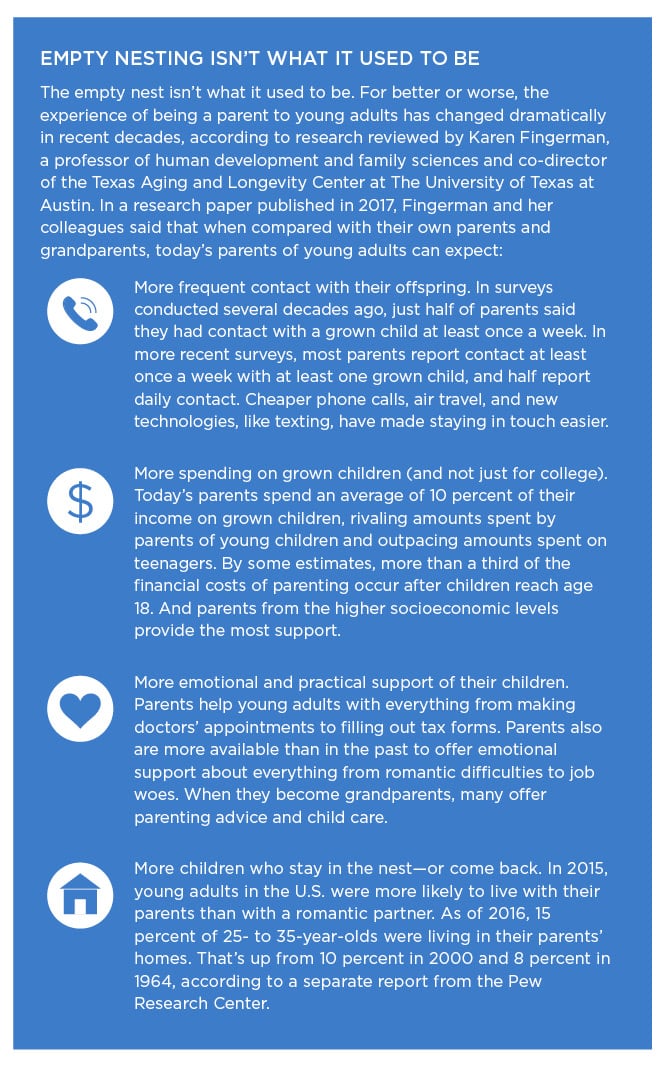
An empty nest does not mean the end of the parent-offspring relationship, especially in our age of easy texting and cheap phone calls.
But it does change that relationship. Ideally, adult children become masters of their own lives, and parents take back seats. That can be tough at times, Gross says. Even today, she says, “I miss my daily routines of seeing my kids after school every day and knowing what they are doing.”
But it helps, she says, that her younger son often calls her on his way home from work and shares news about his brother. The brothers, both launched on careers, own a home together. It also helps, she says, that she’s made her own life in a new community, where she lives with her longtime partner, and has made new friends at her synagogue and elsewhere.
“Sometimes routines can be stifling,” she says. “As long as you understand that change is inevitable, you can navigate this in a positive and exciting way.”
Her co-author, Bishop, says she struggled after her two daughters, now in their early 30s, left home around the same time that her marriage fell apart. In an essay in the book, she remembers walking every Saturday morning with two friends going through similar issues: “We talked about our sadness and our difficult journey for the first two miles, then we turned around and took turns praying for one another during the second two miles.”
Today, Bishop is happily single and lives near both daughters, one of whom has two children. She has found purpose and meaning in her family life and volunteer work.Her message for anyone struggling with the empty nest: “You’re not done yet. There’s life out there, and you have to go get it.”
“To nurture a garden is to feed not just the body, but the soul,” said 18th-century English poet Alfred Austin. He was a lover of nature and wise to the fact that growing your own food turns out to be wonderful for your health. With its many therapeutic benefits to the gardener in addition to supplying fresh and colorful produce, gardening is a double win.
Tending a vegetable garden is a prescription-free way to lower blood pressure, promote heart health, and reduce the risk of age-related memory loss, research from Good Housekeeping shows. Weeding and digging also burns lots of calories while exposing you to vitamin D-producing sunlight.
And, of course, gardeners are more apt to eat plenty of nutritious plant-based foods.
A vegetable patch can be a very effective stress reliever. Gardeners who worked outdoors for 30 minutes were found to have brighter moods and lower levels of salivary cortisol—the stress hormone that contributes to belly fat—than those who relaxed by reading indoors for the same amount of time, according to a 2011 Dutch study in the Journal of Health Psychology.
Light gardening and yard work can keep you trim by burning about 330 calories per hour—that’s more than you’d burn while walking, bicycling, or doing a light workout with weights, according to the Centers for Disease Control.
Gardening can keep your mind sharper longer. In a 2006 Australian study of more than 2,800 people over age 60, daily gardening was associated with a 36 percent decrease in the risk of dementia. Getting your hands in the dirt regularly also exposes your immune system to healthy microorganisms, according to researchers at the University of Colorado Boulder.
Inspired to start your own garden? Spring is still a way off, but the frosty months ahead are the perfect time to make preparations for a vegetable and herb garden for when the first signs of spring appear.
A rich resource for beginner gardeners is a local cooperative extension office, which provides information for homeowners about gardening basics and what grows well in their area. Each county in the U.S. has an extension office that works closely with experts from universities and helps provide information about gardening, agriculture, and pest control.
In most cases, you can find the phone number for your local county extension office in the government section of your phone book or by Googling your state name followed by “extension office.”
But no matter how you plan to get going on your garden plot, there are a few key things every aspiring vegetable gardener should consider.
Select a Spot
Inspect the sunny areas in your yard. Most leafy and root vegetables need six to eight hours of direct sunlight to thrive, while plants with fruits—like cucumbers and tomatoes—require eight to 10 hours. That’s because generating flowers, fruits, and seeds requires the plant to use more energy from sunlight.
You don’t need a big garden at first. “Start small, even as small as four feet by four feet,” says Lucy Bradley, professor of urban horticulture at North Carolina State University and extension specialist at North Carolina State Extension. It’s better to be successful with a small garden than to overextend. If you don’t have a yard, a few 12-inch pots on a deck are enough to provide a household with plenty of lettuce, carrots, radishes, and herbs for salads. You can expand the garden next year as you gain experience and confidence.
Gardens tend to do better on high ground where there is good air movement and less frost. Vegetables need an average of one inch of water per week, so choose a plot that’s convenient to a water source—that way you won’t have to drag a hose too far.
Decide What to Plant
Make a list of what you want to plant, noting the target planting date for each vegetable. “Grow what you and your family like to eat, what is hard to find, expensive to purchase, and what thrives in your climate and soil,” says Bradley.
If you like making homemade pizza, plant heirloom tomatoes, basil, oregano, and peppers. Baby lettuces, dill, and cucumbers could go outside your back door, accessible for salads. Foodies might want to plant specialty vegetables like broccolini or bok choy that aren’t always available in stores. For yards with limited sun, stick to shade-tolerant options like broccoli, cabbage, kale, lettuce, spinach, beets, or carrots.
Plan for a staggered harvest. Arugula and butter lettuce are fast-growing for early harvest. Kale and spinach are known as cut and come again vegetables, because you can snip some leaves and come back for more a few days later. Peas and green beans take time to ripen, though their flavor when you snack off the vine is bright and alive compared to store-bought ones.
Consider adding some edible flowers to your garden like early American settlers did. Marigolds and chrysanthemums, in addition to being a treat for the eyes, provide a habitat for beneficial insects, enhancing pollination. Squash flowers are a delicious treat when battered and fried. Bright orange and red nasturtiums add a peppery punch to salads, plus they deter deer. Minced fresh flowers can be folded into cheese spreads, herb butters, or pancakes.
Evaluate the Soil
The ideal soil holds air, water, and nutrients in a balance of sand, silt, clay, and organic matter. The easiest way to find out what kind of soil you have is to pick up a trowel’s worth and hold it in your hands. Rich, healthy soil is something you know when you feel it: It’s easy to dig and drains well.
A simple home soil test purchased from your local gardening store can help you identify your soil so you can improve it—whether it needs fertility, absorbency, or drainage.
Or you may want to have your soil evaluated professionally by your local extension office. In most counties, you would simply dig up a few soil samples for testing and mail them in. In a few weeks, you’d receive an online report about the makeup of your soil, the pH level, nutrient content, and recommendations for lime or fertilizer to apply to fortify it.
You want soil that is dark, crumbly, and literally full of life. Based on region and climate, though, soil can be gritty, powdery, or sticky when wet. But if you’re working with the red clay of Georgia, the sandy clay of Texas, or the caliche of Arizona, it doesn’t mean you won’t be able to grow a healthy garden.
Keep in mind that using native plants from your region and climate will make your job easier, as these plants are likely well-adapted to the soil of your area.
Consider Raised Beds
If your soil isn’t the best, a raised-bed garden may be a good option. This method of gardening can help keep pathway weeds from your garden soil, prevent soil compaction, provide good drainage, extend the planting season, and serve as a barrier to pests such as slugs and snails.
“Raised beds are useful where the ground soil stays too moist for healthy roots or the soil is highly compacted or contaminated,” says Bradley. Raised beds can be fancy or simple, and they can be built from wood, stone, or any materials that haven’t been treated with chemicals, since those could leach into the soil.
A common approach is to use stacked 2″ by 6″ boards joined in the corners by 4″ by 4″ posts. Another approach is to use concrete blocks. While less pleasing to the eye, they are inexpensive to source and easy to use. On the market are also prefab raised garden bed solutions, which are made from long-lasting polyethylene that is UV stabilized and food grade, so it will not leach undesirable chemicals into the soil or deteriorate from being outside in the elements.
Start Seedlings Indoors
For a head start, you can start seedlings indoors while it’s still cold out. About six to eight weeks before the planting date, sow the seeds in containers of soil, following the packet directions. As a rule of thumb, plant the seeds two or three times as deep as the diameter of the seed, and cover lightly but firmly, making sure there is good contact with the soil.
Cucumbers, for example, need soil temperatures of at least 60 degrees, but you can plant the seeds about one inch deep in cups or pots. Once they reach four inches in height, they’re ready for transplanting. Before moving seedlings, take a few days or a week to harden them to the weather by putting them outside for a few hours each day. The plants should be spaced two feet apart in rows that are four feet apart, or near a trellis so they can climb upward.
After the danger of frost is past, you can plant the rest of your seeds and add small plants from garden centers, catalogs, or online. Staggering planting of, say, sections of lettuce, at one- to two-week intervals, sets you up for continual harvest later in the season. As you harvest a crop, you can replant that area. As you care for your green charges, you might find yourself so absorbed by their natural rhythms that time flies by unnoticed, worries fall away, and your heart rate slows. Between eating lots of fresh produce, spending more time in the sunshine, and getting regular exercise, don’t be surprised if your next medical checkup shows positive results.
Sooner or later, there will come a time in each of our lives when we will want to downsize. Some may want to simplify their lives after launching their now-adult children into the world. Others may want to rid themselves of their cumbersome earthly possessions to pursue a life of travel and adventure. In other cases, the catalyst may be a difficult life event. For example, keeping up with home maintenance after a health decline or spouse’s death may force the need to downsize.
Regardless of the catalyst, when that time comes, many of us find that the actual act of downsizing is fraught with emotional hurdles and anxieties that can cause us to delay or indefinitely pause moving forward.
A wall full of books, a china set (or two), rooms full of furniture that sit unused, clothes, photos, souvenirs, and memorabilia from a life well-lived: Rather than owning these things, sometimes it feels like they own us.
We’ve lived with some of our possessions so long that they become part of our stories—and how we define ourselves. Some of our things stir deep memories and carry sentimental value.
But what is this mysterious hold that our possessions have on us? What can we do about it so that we can move forward with less stress and anxiety?
Hold on Tight
I paid good money for it, so I can’t just give it away, right? And besides, I may need it later, so I’ll just put it back in the closet.
Does this sound familiar? If so, you’re not alone. And it’s not a phenomenon driven by American consumerism or conspicuous consumption, both of which are recent developments on the human timeline. It goes way back.
For example, in the first sermon after his enlightenment, the Buddha observed that attachment is the root of much of our suffering. Attachment can take many forms: attachment to people, possessions, ideas, or a way of life. Our desire to have these things—or our fear of losing them—is what causes this suffering. That was 2,500 years ago.
Modern behavioral science seems to bear out this ancient wisdom.
One explanation is the endowment effect, a well-studied human behavioral bias toward valuing objects we own more highly than objects we don’t own. Simply put, once something becomes ours, it becomes harder to let go of. The endowment effect applies to ownership of things large and small—from houses and cars to pens and coffee mugs—regardless of how often we use them. We weigh their worth more heavily because we possess them.
Loss aversion, a survival mechanism that served our species well through periods when food, shelter, water, and other necessities of life were difficult to obtain, is a closely related behavioral bias. This fear of losing what we have causes us to place a higher value on things already on our possession.
A significant body of research has also shown that we place value on the things we own because we view them—consciously or not—as an extension of ourselves. And we view gifts as an extension of the giver. These feelings can make letting go of these possessions feel like an abandonment.
These complementary behavioral biases conspire to cause us anxiety when we are faced with giving something away—or even thinking about it. But you don’t have to fall prey to these biases.
Fight the Power
Once you’re resolved to downsize, put together a plan for what will go where. Be realistic about what you can sell—and the prices you might get—and recognize that even your family may not value your heirlooms as highly as you do. An industry of service providers has sprung up to assist, so don’t feel like you have to go it alone.
The more organized you are, the better able you will be to deal with the endowment effect when it rears its ugly head. While it can have a strong hold on our minds and behavior, a few helpful tricks can help break—or at least lessen—its grip, allowing us to liberate ourselves from our stuff:
Become aware. The first step toward liberation comes from recognizing the pangs of anxiety caused by the endowment effect. If you’re downsizing, that shouldn’t be hard to do. It’s the feeling you get when you open the cupboard and imagine giving your wedding china to one of your grown children. It’s the feeling you get when you consider adding your alma mater sweatshirt to a bag headed for Goodwill. When that pang hits, hit pause.
Reframe it as a mind trick. The moment you hit pause, you’ll be staring the endowment effect in the face. Tell yourself that the feeling you’re experiencing is a mind trick trying to make you do its bidding. It’s not real. It’s an unhelpful behavioral pattern, and it’s not what you want. When you do that, you separate yourself from the feeling, lessening its hold on you. Interestingly, even imagining that you no longer own it—whatever it is—will weaken your mental attachment to it.
Refocus on your vision. Remind yourself of what you’re doing and why. Imagine your new life without a big house to keep clean, a mortgage to pay, a leaky roof to fix, or leaves to rake. Walk through your future in your mind, noting only the things you will need. If you’re still having trouble, it may be helpful to write out the reasons why you are downsizing and keep them where you can see them. You do not have to respond to every impulse your brain generates.
Reinforce your goal with action. With that vision of your uncluttered future etched in your mind, pull the trigger. This is the toughest step. Load your excess furniture into the truck. Seal up the box of books (or china or knickknacks). Put it in the trunk, drop it at its destination, and don’t look back. You won’t regret it. The funny thing is, the more you do it, the better you’ll feel. And the better you feel, the more you’ll do it. A virtuous cycle will begin.
Take a picture of it. Snap pictures of items with deep sentimental value—and then get rid of them. It’s the memory you value, not the item itself. And the human brain cannot differentiate between high-resolution images and the real thing, so your digital photo album should allow you to relive those pleasant memories just as effectively as the item itself.
Make a time capsule. You may find there are some things that you’re on the fence about. If so, put them in a box, seal it up, and date it. Store it in a cool dry place. In six months, if you have not opened the box or needed any of its contents, send it off to an appropriate recipient. Six months out of sight and out of mind should be enough to break the tie.While the process may seem daunting, one bright spot is the fact that practice makes perfect when it comes to downsizing. If you’ve edited your belongings over the course of your life, it will be easier to make bigger changes later on. And if you’ve got the luxury of time before your big downshift, start practicing now. Weed through your drawers and closets. Donate unused furniture, electronics, and clothes. Doing some of the work now will prove to you that your possessions don’t own you and lighten the burden later.
Seamus Mullen grew up on a farm in Vermont and trained as a chef in Spain. By his mid-30s, he was a New York City restaurateur, earning rave reviews and celebrity attention.
He also was a physical and mental wreck.
“My body was just falling apart at the seams,” says Mullen, known for appearances on TV shows such as The Next Iron Chef and Chopped.
The once-athletic Mullen had been diagnosed with rheumatoid arthritis (RA), a chronic inflammatory autoimmune disease that causes pain, swollen joints, and severe fatigue—and requires patients to take medications that dampen the immune system. He’d also endured two spinal surgeries, a pulmonary embolism, and a nearly fatal bout of bacterial meningitis. He walked with a cane, weighed far too much, and was reduced to using his beloved racing bike as wall décor.
“My mindset was, I don’t have time to be sick, so just tell me what medication to take,” he says. After each crisis, he dutifully took his medicines and “went back to my normal state of being, which was pretty terrible but functional,” he says.
After a particularly harrowing two-week hospitalization in 2011, Mullen says, “I realized that something had to change.”
And that something started with his diet.
Despite his training, the chef, like many of us, was eating a lot of junk: indulging in potato chip cravings and gulping down pizza, pasta, ice cream, or whatever he could find in the wee hours after work. He says he knows now that he was eating and living in a way that made his problems worse.
Today, Mullen is a firm believer in the idea of “food as medicine”—that the foods we choose can play a central role in the prevention and treatment of illness. He’s written two books, Real Food Heals and Hero Foods, to spread the word.
“There is no illness on the planet that doesn’t benefit from a healthy relationship with food,” he says.
In his case, Mullen says, the benefits have been life-changing. Now, he says he’d like to see another change: a healthcare system that recognizes the healing power of a well-planned meal.
That’s a goal that an increasing number of healthcare professionals heartily endorse.
Food as Medicine
The idea that food has medicinal power is hardly new. Hippocrates, the ancient Greek physician, supposedly once said, “Let food be thy medicine and medicine be thy food.”
It’s a concept that “Western medicine forgot” for a while, says James Gordon, founder and executive director of the nonprofit Center for Mind-Body Medicine in Washington, DC. Gordon, who is a psychiatrist and a clinical professor at Georgetown Medical School, says, “We are now starting to recover that understanding.”
For the past 20 years, Gordon’s center has offered food-as-medicine training programs to health professionals, educators, and others. Gordon devotes a full chapter of his latest book, The Transformation: Discovering Wholeness and Healing After Trauma, to the power of diet for people recovering from trauma.
“Certainly, 30 years ago, anybody who was talking about nutrition in medicine was looked at quite skeptically by the medical establishment,” Gordon says. “There’s still skepticism, but also more interest in investigating.”
While experts debate the details of exactly what to eat, even the most mainstream medical organizations now include diet in guidelines for treating conditions such as heart disease and type 2 diabetes.
For example, the American Heart Association says that people with mildly elevated blood pressure should exercise more and change their diets—adding fruits, vegetables, and whole grains, and limiting salt and sugar—before trying medication. Cancer patients also are urged to eat healthfully during and after treatment to aid recovery and help prevent recurrences. The American Institute for Cancer Research recommends survivors focus on a plant-based diet. The group also says that obesity, fueled by junk-food diets full of sugar and fast foods, is an important cause of inflammation, an underlying cancer cause.
Meanwhile, Gordon says evidence is growing around the role of diet in treating mental health conditions, such as depression, anxiety, and post-traumatic stress disorder.
Despite the evidence, he says, “Nutrition is not taught or is very scantily taught in most medical schools.”
And all those dietary guidelines? Patients are lucky, he says, if they get a fact sheet about them from their doctors—much less detailed information about how to incorporate them into their lives.
Translating Science to Action
There are places, though, where the science of food and health is making its way into the healthcare system’s bloodstream and onto patients’ plates.
“I see patients all the time with diabetes and hypertension. I prescribe them medicine and tell them this is just half of the equation,” says physician Rita Nguyen, an assistant clinical professor of medicine at the University of California San Francisco and an assistant health officer at the city’s public health department.
But Nguyen and her colleagues don’t stop at handing out a few diet tips. Instead, they invite many of their patients to weekly “food pharmacies.” The Saturday events are set up like farmers’ markets, with tables of fresh produce, cooking demonstrations, and samples of spices, olive oil, and other healthy staples. Participants also can speak with dietitians and get information on food assistance programs. A local food bank and several business partners donate the goods.
Nguyen also is part of a research project in which patients with heart failure spend two months eating only meals carefully designed for them by dietitians. Such “medically tailored meals” have been shown to improve diabetes control and increase HIV medication adherence in previous studies. One big question is whether such short-term interventions can permanently shift eating habits, Nguyen says.
Change also has come to some of the nation’s medical schools. At Loma Linda University Medical School in California, all students learn about incorporating diet and other lifestyle factors into treatment plans, says Brenda Rea, an assistant professor of preventive and family medicine. The university is also one of a few in the nation with a residency program in lifestyle medicine.
Rea, a physician, says she became passionate about the need to help patients change their diets in her first career as a physical therapist seeing stroke survivors. “I saw my patients coming in with second heart attacks, third heart attacks, second strokes,” she says. Many of those people, she says, got no help with their diets.
A Chef Heals Himself—with Food
For Seamus Mullen, the turning point came after he was hospitalized for bacterial meningitis, suffering from a brain-boiling 106-degree fever and terrible headaches. He recalls a classic near-death experience: “My body, my internal organs, everything started shutting down,” he says, and then he felt himself drifting toward a “peaceful light.” He believes he willed himself back to consciousness.
After recovering, Mullen went back to his daily routines, taking medications that warded off painful RA flare-ups but left him in a low-energy daze. Mullen now believes that many of his health problems stemmed not only from the bodywide inflammation associated with RA, but also from a gut ravaged by multiple infections and antibiotic treatments.
Until that point, he says, none of his doctors had said much about his diet. Then a friend introduced him to a new doctor, a specialist in integrative medicine—a field that combines conventional and alternative approaches. He convinced Mullen to fight for his health with a familiar weapon: his fork.
With the doctor’s guidance, Mullen made major changes, cutting added sugar and refined carbohydrates and loading up on colorful vegetables and what he calls “good fats and proteins”—foods such as wild seafood, avocados, and nuts.
For a while, Mullen says, he took pictures of everything he ate and learned which foods made him feel best. He learned, he says, that he can’t eat much dairy and should stay away from gluten—the proteins in wheat and some other grains that cause trouble for people with celiac disease and other forms of gluten intolerance.
He also learned to load up on foods that feed healthy gut microbes, including cruciferous vegetables and fermented foods such as sauerkraut and kefir.
“It was six months before I noticed any difference, but when I did, it was radical,” he says. “I went from not being able to get out of bed without having extreme pain in my hands and feet to one day walking down the stairs and not having any pain at all—and only realizing it when I was halfway down.”
He also started losing weight—lots of it, eventually totaling 70 pounds. “My objective was to feel better,” he says. “Weight loss was an unintended side effect.”
At the same time, Mullen started prioritizing sleep and exercise. Soon, his racing bike came off the wall, and in 2014, he raced in La Ruta de los Conquistadores, a difficult three-day trek across Costa Rica.
By then, Mullen says he had achieved an even more unlikely goal: He had lost all symptoms and biological markers of RA and no longer needed painkillers or drugs to suppress his immune system and fight inflammation. He says he remains free of RA signs today.
Mullen concedes that not everyone who follows his lead will see such dramatic changes: “Everyone is an individual.”
In fact, while many patients with RA report symptom improvements after dietary changes, research has not proven a cause and effect relationship, says Marcy O’Koon, senior director for consumer health at the Arthritis Foundation. She says there’s no research suggesting diet is a “substitute for disease-modifying drugs,” but “that doesn’t mean diet has no influence.” And it’s quite likely, she says, that weight loss helps, because body fat has proven inflammatory effects. In general, she says, it’s smart to eat lots of vegetables, fiber, and healthy fats, including inflammation-fighting omega-3 fatty acids found in nuts and fish.
Mullen, who now lives in California and works as a podcaster and nutritional consultant, says he has no doubts that changing his diet totally transformed his life.In his most recent book, Real Food Heals, he puts it this way: “Each day, I feel a little bit stronger, a little bit more complete. This experience has been nothing short of a miracle for me.”
On an early December night, in a North Carolina Central University classroom, Ravila Gupta sat exhausted as a law school professor discussed torts. Night school was Gupta’s only option, since she was working full-time as an engineer. She was making use of every moment, memorizing legal outlines in her car when she pulled up to red lights, and opening her books to study when she got home at 10 p.m. every night. Every minute was precious.
Gupta felt like she’d chosen to step off of the world for four years, exiling herself from her friends, from her life—giving up time with her family and time for herself. It was all so hard. But was it worth it? “I just can’t do this anymore; it’s far too much,” Gupta thought. “This is too big a price to pay.”
Then she thought about something else. Her six-year-old son, Neel, sitting in the back of the law classroom with the other children whose parents didn’t have childcare. If she quit now, what message would that send him? If she didn’t do something because it was hard, what kind of role model would she be?
The questioning moments of defeatism Gupta felt as a law student were out of character. Gupta is a charge ahead, tackle anything kind of doer who is not at all prone to self-doubt. The decision to stay the course, get her J.D. and keep forging ahead was a more accurate reflection of the woman who today is the president and chief executive officer of the Council for Entrepreneurial Development (CED).
Forging Ahead
Founded more than 35 years ago, CED is North Carolina’s oldest nonprofit dedicated to strengthening startups in the state. It connects foundling companies and visionary entrepreneurs with resources, financial backing, mentorship, and each other.
Gupta took its helm in 2017. At the time, she had no entrepreneurial experience save watching her parents open and run a furniture business in their retirement. It didn’t matter. Gupta had no doubt she could do it. In fact, she knew the job would combine all the skills and ways of thinking she’d honed over an ambitious and winding career path.
Gupta started out as an engineering student, along with her two sisters. They were the first trio of female siblings to graduate from McGill University’s engineering program. But to the girls, their accomplishments were simply expectations met—to-dos checked off a list.
“We lived in a house where hard work was something that you just did,” Gupta says. In the 1960s, her parents emigrated from India to the U.S., where they hoped to make a better life for themselves. Her mother rose through the ranks as an executive, and her father was an engineering professor. For their daughters, there was no option: Education was the ultimate priority. “School was just what you did,” Gupta says. “There was no question about how hard you’d study or that you were going to continue studying.”
Fortunately for Gupta, the pressure to excel in school never created an aversion to learning. Instead, learning became a lifelong passion. This quest for knowledge has propelled her every professional move, from her early days as a chemical engineer who switched into environmental engineering. Then, as an engineer who went to law school. A lawyer who became a company president. And a president who took a look at everything she had to offer and decided to give back.
This thirst for learning kept Gupta in her seat in that law school classroom three nights a week, where she hoped she’d learn a new way to approach problems and gain a new skill set.
Studying the law indeed provided a whole new lens through which to view things. Her engineering experience had trained her to see the world as a series of problems and solutions. What was wrong—and how she could fix it. But from a legal perspective, nothing was binary or empirical; the solutions were always tempered with pros and cons and consequences.
“When you’re trained as an engineer, there’s always a problem, and you’re trained to find answers,” Gupta says. “As an attorney, you’re trained to look at options and downsides.” As both, Gupta says she became solution-driven but also aware of the bigger picture, cognizant of all the possibilities and repercussions.
Well, Why Not Me?
Gupta took a job at a Raleigh law firm after graduation, but in 2008, she moved on to be general counsel at Umicore USA, a subsidiary of the Brussels-based materials technology and recycling company that employs more than 10,000 people and brings in more than $10 billion. Three years later, Gupta was Umicore USA’s president.
It was a heady position, punctuated by surreal opportunities. During a roundtable discussion on foreign investment that Gupta was invited to at the White House, she strolled around the table looking for her name card. She finally found it, next to an unmarked place with a blue folder and a cup of green tea: President Barack Obama’s seat.
“Well, why not me?” Gupta thought as she took her seat beside the president’s.
She was the only woman at the table. Indeed, Gupta is the only woman and person of color at many of the tables she sits at. But those are aspects of her identity that don’t take up much headspace.
“I don’t lead with that. I have a heritage and culture that’s really rich, and it’s shaped who I am, but I just view myself as trying to do the best I can,” she says. “It doesn’t even come to my mind a lot of the time.”
What does come to mind—all the time—is how to keep learning.
That manifests in simple, day-to-day things, like Gupta’s obsession with nonfiction reading. Gupta is never without a book, and she reads constantly, everything from biographies to a recent release explaining all facets of the human body. “I can’t put that book down because I’m gaining knowledge at all times,” Gupta says.
“I just have this insatiable desire to know things and understand, and it helps me connect dots in the world.”
After nine years at Umicore, Gupta was also connecting the dots of her own career. She loved her job at Umicore USA, and it was a company she felt great about working for.
But was there something new to learn elsewhere?
Connecting the Dots
“I’ve constantly been on a journey,” says Gupta. “Every single job. It was like, OK, what can I learn from this person? What can I learn from this decision? What can I learn from this industry? I didn’t realize early on that that’s what I was doing—I felt like I was just being myself, and I was constantly searching for knowledge from people or new ideas.”
Gupta knew herself and knew what motivated her. She needed to master something new. And she wanted to do something beyond learn; she wanted to teach. Over the course of her career, she’d amassed not just a wealth of skills and a trove of knowledge, but multiple ways of viewing and solving problems.
She’d also shaped herself into an astute leader. Inspired by executive coaching she received as Umicore’s president, Gupta had gone back to the classroom yet again, to earn her coaching certificate. She learned that the way she tended to jump in and solve problems her team was having was not as effective as helping them realize and develop their own solutions.
“I noticed that my coach never told me what to do or how to do it, but she asked me questions,” Gupta says. “And I began to realize that the answer is actually inside, you just need to pull the answer out.”
As she learned to coach and applied the practices to her own team, Gupta saw how powerful an approach it was. It forced her to step back and to allow space for creativity. And it allowed her to build strong, invested teams.
Gupta decided she wanted to apply all of her executive and leadership experience to a smaller team she could really influence, with a mission-driven focus she could feel passionate about. She wanted to lead an organization she could personally reshape.
Paying It Forward
It was perfect timing for CED, whose chief executive officer and president was stepping down just as Gupta was looking for that unicorn role that would make use of her combined experiences.
“I was looking for a place where I could take everything I had and all the leadership skills I’d developed and be super impactful, just really help an organization transform itself,” Gupta says. “Can I take everything and put it in one place and see the results of my work in a very quick manner?”
Less than three years later, the answer seems to be yes.
Gupta has already presided over a major overhaul of the organization’s business model and strategy, a move she expects to result in increased funding, financial sustainability, and improved engagement.
After Hurricane Florence foiled CED’s biannual tech conference plans, Gupta quickly rebounded by combining it with the organization’s upcoming life sciences conference—a revenue-saving move that also produced a synergistic joint event she now plans to replicate every year.
Gupta also gets to see her work transforming CED reverberate through the entrepreneurial companies it supports.
“The nice thing about CED is you have direct impact to an entrepreneurial company, and that impact can be large,” she says. “That’s what’s really exciting about it. As a small team of nine people, when we touch a company, we see it right then.”

There are plenty of those ambitious young companies to reach out to. North Carolina is home to a unique and incredibly collaborative ecosystem of startups of many stripes. Having both tech and life sciences in the same, supportive scene is special in and of itself. And they’re not just ambitious, but incredibly successful, too. Companies in North Carolina brought in a record $2.7 billion in venture funding in 2018, led by Epic Games, Precision BioSciences, and Humacyte.
“This area is so special. It’s grown so much in the last however many years, and the ecosystem here has really blossomed a lot,” Gupta says. “It’s very collaborative, and it’s very encouraging for companies.”
CED helps entrepreneurs navigate their way around this ecosystem, providing connections, support, and guidance as they look for assistance of all sorts. “I think that’s really, really important, just to make sure that they know this community’s behind them and wants them to succeed,” says Gupta.
Failure is not an option. Gupta doesn’t believe in it. There are setbacks and obstacles, challenges, and perhaps disappointments. But she doesn’t trade in doubts or fears. Not when it comes to her own life and work, and not when it comes to others’. That kind of certainty can be a kind of sword and shield all its own for the startups Gupta works with.
The Greatest Joy
When Gupta speaks with entrepreneurial leaders, she keeps them in touch with their why—the passion behind their all-consuming project. She personally helps companies understand how they can share the story behind their company and the importance of doing so. She tries to keep them feeling steady as they weather the ups and downs of an uncertain and high-stakes life.
For Gupta, her why is simple. It’s her team. And it’s there that Gupta feels she’s made the greatest contribution. She encourages their passions and sets a unified direction. She brings them opportunities for professional development so that they can keep learning and growing.
“For me,” she says, “that’s been the greatest joy.” Perhaps a new learning opportunity will present itself alluringly to Gupta in the future—maybe even a startup idea of her own. But for now, there’s plenty of pleasure to be found both within and beyond work. In the pages of a fascinating book, of course. But also, in her travels around the world. In foreign cities, Gupta makes it a special mission to find the best and most authentic restaurants to try. She especially loves embarking on those quests with her son—the 30-year-old venture capitalist in London who was once a little boy sitting in the back of the classroom looking up to his mom.
In 2015, Karen Denise walked into an animal shelter to volunteer as a dog walker. Having grown up with dogs, she had always loved spending time with them, though her busy work schedule precluded getting her own permanent pet. “I have commitment issues,” she joked. While there, she learned about a new opportunity—fostering dogs.
It’s said that when you foster an animal, two lives are saved. The dog that’s removed from an overcrowded shelter is spared from possible euthanasia, and a space is opened up for another dog. “That altruistic part really appealed to me,” says Denise, senior director of wealth client services at CAPTRUST in Raleigh.
She signed up for the foster program and soon got a call about Mighty Mouse.
A three-year-old shepherd mix who had been a stray, Mighty Mouse had a comical appearance due to a medical condition that caused his eyelids to roll back. The animal shelter had scheduled corrective surgery to make him healthy for adoption, but wanted Denise to take him afterward and provide a calm environment for recovery. As he healed in her home, he became relaxed and playful, and he seemed to know she had helped him. “I felt Mighty Mouse was very grateful to be out of the shelter,” says Denise, who kept him for a few months until he was adopted.
Denise felt she had gotten as much, if not more, out of that fostering experience as Mighty Mouse did. So, she kept going. And going.
The next call that came was for a pit bull mix, Lucy. “A lot of people are drawn to puppies the same way they are drawn to babies,” says Denise. At eight years old, Lucy was an older dog who was at risk of being euthanized. “She had the saddest eyes, and she was on doggy death row with a ‘final hold date’ for the following week. So I said ‘OK, I’ll foster this dog.’”
With Lucy, it was not love at first sight, but it grew into love. Lucy proved to be fiercely protective, and the two bonded to such a degree that Denise would find herself in tears when families showed interest in possibly adopting Lucy. It soon became clear that she was meant to keep Lucy for life. “She was the sweetest dog, and I had her for four years,” says Denise.
When you’re a dog lover without a pooch in the house, nothing else can really fill that dog-shaped hole. Though you crave the companionship of a furry friend, there’s often some good reason or other—travel, complicated lives, commitment phobia—why it’s not the right time to add a permanent pet to the family.
Puppies are adorable, but many households aren’t ready for a partnership that can last 12 to 15 years. But fostering a dog can be deeply fulfilling, without the commitment.
“A lot of people don’t know about fostering. They think adoption is the only way to help,” says Denise. If you have the space for a four-legged guest, there are foster opportunities ranging from a few hours to a few years.
“There are always animals needing to be fostered. The summer is especially busy for puppies and kittens, because animals go into season in the spring and have litters,” says Chelsey Bosak, foster home recruiter and programs department administrative coordinator for Helping Paws, Inc., of Hopkins, Minnesota.
Helping Paws relies heavily on foster families, although it doesn’t work with shelter animals. The nonprofit organization trains service dogs who are bred for the job for two and a half years and places them with individuals with physical disabilities, veterans, or first responders with post-traumatic stress disorder.
The volunteer foster home trainers take home the puppies when they are eight weeks old and take them to classes each week to learn necessary skills, such as opening doors, picking up items, and taking care of their people. “It’s a big responsibility, like having a child in your home. By the time the dogs graduate, they’ve been trained into service dogs,” says Bosak.
Benefits of Fostering
A growing body of research shows that fostering, even short term, greatly improves shelter dogs’ wellness and helps them get adopted. Animal foster programs have evolved to offer more flexible options to volunteers, so that people with limited time or resources can host a pet, too.
Foster programs save shelter animals’ lives and help them find homes more quickly. When foster families take dogs out to restaurants and parks, they’re more likely to attract the attention of potential adoptive families who might otherwise have gotten pets from breeders or pet stores, according to a 2014 study published in the journal PLoS One.
Fostering relieves pressure on overtaxed animal shelters and makes dogs more adoptable. In one study, dogs with low chances of adoption due to poor health or age were placed in foster homes temporarily. After returning to the shelter, their average odds of eventually finding a permanent home increased fivefold, according to a 2018 study published in the journal Animals.
Short foster home stays help dogs get socialized and bring out attractive aspects of their personalities. “The shelter is kind of a depressing place. The dogs, especially if they came from a home, can be very confused, and their personalities don’t come out,” says Denise.
Even a one- or two-night stay in a comfortable home gives pups a break from the shelter and decreases their stress. Dogs awaiting adoption at four animal shelters had lower levels of cortisol, a stress hormone, and showed other physiological benefits after spending two nights in a foster home, according to an Arizona State University study.
Types of Dog-Foster Programs
Want to foster a dog? Short outings and weekend programs are becoming popular, along with adult dog fostering. Options run the gamut from an hourlong walk in the park to a hosting and training relationship of a few years.
Field trips. If you can’t have a pet due to your schedule, or you’re considering adoption, a brief doggie date can be a fun way to get familiar with different breeds and learn what would suit you. Shelter dogs delight in a trip to a park, a walk in the woods, or a chance to practice basic obedience commands like “sit” or “stay.” Plus, the resulting photo ops can improve adoption chances.
Sleepover or weekend fostering. A one- or two-night visit provides a fun experience for humans and measurable health benefits for the dogs. Check to see whether animal shelters in your area offer weekend or holiday fostering events that could be something novel for your family to do.
Adult dog fostering. Since people love adopting puppies, adult dogs often languish in shelters. Older dogs are in desperate need of temporary homes where they can feel cared for and calm. They show improvements in happiness, mood, and friendliness after just one day in foster care, with even greater well-being after longer periods, according to Maddie’s Fund, an animal welfare foundation with headquarters in Pleasanton, California.
Service dog training. This intensive volunteer opportunity isn’t for everyone, but long-term foster families are needed to host service dogs in training. “We have all different kinds of people fostering—college students, families with kids, and couples with other animals in the home. We get some empty nesters who are looking for a passion project. The biggest thing we look for is someone who can commit to the two-and-a-half years, and then be able to pass that dog along to the person who is going to receive the service dog,” says Helping Paws’ Bosak. Saying goodbye to a dog you’ve helped train from a puppy might be the toughest part, but you’ll have the satisfaction of sending him or her on to a useful career.
To find service dog opportunities near you, Bosak suggests searching for an accredited service dog organization through Assistance Dogs International (assistancedogsinternational.org) and contacting them to ask about fostering.
For those who believe they could never foster a pet because it would be too hard to say goodbye when the pet is adopted, consider the alternative. You become an important part of the mission to save homeless pets by not only giving that individual animal hope, but also by making a difference for all animals. It may be hard to say goodbye to a dog after you’ve bonded with him or her, but it’s important to remember that by opening your home, you are saving a life—and each pet you foster is a new life saved.
Strategy #1: Bunching Charitable Deductions Together Every Five Years into a Donor-Advised Fund
If you make more than $10,000 a year in charitable contributions, it is unlikely that your total itemized deductions will exceed the $24,000 standard deduction, and you will not receive any tax benefit for your annual charitable contributions.
By bunching the next five years of contributions—for a total of $50,000—into a donor-advised fund, assuming a 30% effective federal tax rate, you can save around $7,800 in taxes during the year of the contribution. If done one more time over the next 10 years, the tax savings should total around $16,600 over that period.
Strategy #2: Using Appreciated Stock (or Funds) to Make a Donor-Advised Fund Contribution
If you have unrealized gains on stock or mutual fund holdings in a trust, transfer on death (TOD), individual, or joint investment account, you can gift appreciated shares or units directly to a donor-advised fund. Assuming $20,000 of unrealized gains out of the $50,000 donor-advised fund contribution described above, and a 29% total capital gains tax rate (federal, state, investment income tax), approximately $5,700 could be saved each time—for a total of $11,400 over the next 10 years.
Strategy #3: Backdoor Roth IRA Conversions
If you are saving money outside of your retirement plan, the first dollars should go into Roth individual retirement accounts (IRAs) for you and your spouse. For taxpayers who earn greater than $200,000, direct Roth IRAs are not allowed. However, a “backdoor” Roth strategy may work. A contribution is made to a non-deductible traditional IRA and immediately converted to a Roth IRA. Since no tax deduction was taken, no taxes are owed at conversion.
Over the next 10 years, by saving the first $14,000 per year ($7,000 each), the Roth accounts would be worth approximately $45,000 more than if they were invested in after-tax accounts (and sold, with taxes paid at 29%). This benefit should increase each year going forward.
Strategy #4: Implementing a Cash Balance Plan
If you are considering or already implementing a cross-tested profit-sharing calculation for your 401(k) or profit-sharing plan, consider adding a cash balance offset plan to provide significant tax savings each year. If additional cash balance contributions of $100,000 are made each year (assuming a 37% total tax rate), $37,000 per year in tax savings is possible. Over a five-year period, $500,000 of contributions would be made (plus earnings), and $185,000 in total taxes would be saved.
Strategy #5: Tax Loss Harvesting
In a year like 2018, where stock markets drop in value, a proactive tax-loss harvesting strategy can offset future capital gains without likely affecting future investment returns. As an example, if $100,000 of capital losses were taken during 2018 (and immediately invested back into similar strategies), you can offset the next $100,000 in capital gains in future years. If net losses remain, $3,000 per year can be used to offset ordinary income. Assuming a 29% total capital gains tax rate, that is $29,000 in future tax savings until the losses are used.
Strategy #6: 529 Plan Contributions
If you have four children or grandchildren, contributing the maximum state of Ohio tax- deductible amounts of $4,000 each to the state 529 education savings program can save Ohio taxes. The overall savings, assuming a 5% Ohio tax rate, is $800 of Ohio tax savings per year.
Strategy #7: Prudent Investing/Investment Policy – Value of Discretion
Emotional and reactive decision making by investors can dramatically and negatively impact performance. Over the period from 2013 to 2018, the CAPTRUST Moderate Growth Strategy provided a cumulative investment return of 12.99% vs. the average retail investor of 7.73%—or just over 1% per year on average. (Source: DALBAR Quantitative Analysis of Investor Behavior for the period ending 12.31.2018.). For a portfolio of $1,000,000, 1% per year is approximately $10,000 per year in additional account value.
Strategy #8: Active Rebalancing
While there is no free lunch in investing, rebalancing consistently comes close. In their 2016 paper, “Advisor Alpha,” Vanguard estimated that active, consistent rebalancing adds 0.10% per year in additional returns—basically by selling small amounts when they are high and reinvesting in portfolio areas that are not. Assuming $1,000,000 in an investment portfolio, this could add approximately $1,000 in additional account value each year.
Strategy #9: Life Insurance Policy Review
Life insurance is an essential but undermanaged component of many families’ financial plans. It can help provide you liquidity to pay estate taxes, fund a shareholder buyout, protect a company from financial loss in the event of a loss of a key employee, or provide tax-free retirement cash flow. It is important to monitor your policies’ performance to make sure they continue to meet the expectations set when you purchased them, and to verify that your policies’ current premiums and fees are competitive.
A consolidated life insurance portfolio review provides reporting to produce clarity and increase transparency so that you can make important decisions about your coverage with confidence. Policy reviews often lead to alternatives such as tax-free income at retirement, reduced premiums for the same amount of coverage, or increased coverage for the same amount of premium.
About CAPTRUST
Founded in 1997 in Raleigh, North Carolina, CAPTRUST is an independent registered investment advisor with more than 650 employees nationwide and $362 billion in client assets. An employee-owned firm, CAPTRUST provides investment advisory services to retirement plan fiduciaries, endowments, and foundations, and comprehensive wealth planning services to executives and high-net-worth individuals. CAPTRUST’s mission is to enrich the lives of its clients, colleagues, and communities through sound financial advice, integrity, and a commitment to service beyond expectation. The firm also operates the CAPTRUST Community Foundation, a charity focused on meeting the needs of underserved children.