Retirement had not been the plan. Ward was at the top of his game. In fact, he was a day away from publicly announcing a three-fight deal with HBO—a cherry on top of an unbelievable mound of victories.
But he felt overwhelmed and burdened. Maybe it was time to stop. Tears began rolling down his cheeks as he let the words come out. He thought it was time to end the boxing career that had consumed and propelled him for 23 years.
Ward wasn’t accustomed to crying. He was used to winning. In the 13 years he’d been a professional boxer, he had never lost a single match.
A Look Back
Ward grew up in the Bay Area of California, where his first love was baseball. But when his dad started telling him stories about his own amateur heavyweight career, it was game over. Ward wanted to be like his dad—a fighter.
There was plenty about Frank Ward not to emulate. He was a functional heroin addict: an engaged and well-meaning business owner and father, but one who couldn’t slip or weave out of addiction, emerging blank and distant from his room. Ward wondered how the man he regarded as Superman could transform so entirely.
Ward’s mother had already succumbed to her illness. She was a full-blown addict who lived on the streets for the better part of Ward’s youth.
Ward used to wait for her to keep her promise to come home, watching out of his window. Sometimes, she would come back. But it was mostly to demand drug money from Frank Ward, not to see her son.
Nevertheless, Ward never saw himself as a victim. “I had real hardships around me, but I didn’t grow up in the slums; I wasn’t a kid who had absolutely nothing,” Ward says. “I had a good family base even though my family had issues.”
As a single dad, Frank Ward was a no-nonsense guy and the most important man in his young son’s life. He took the 9-year-old Ward to Virgil Hunter, the man who would become his coach and godfather, and asked a question: “Can you teach my son how to hit and not get hit?” Hunter could, and he did.
Becoming the Best
Though Ward couldn’t have articulated it at the time, boxing was an escape. It didn’t matter that his dad was back in rehab or that they really were losing the house this time. In the ring, as his body ached with effort and his ears rang, and his opponent’s sweat rained down around him, he felt a sense of total peace.
Ward fought his first amateur boxing match when he was just 10 years old. He put everything he had and everything he was into the sport. And it showed. He went 115 and 5 in his amateur career and won a gold medal for the U.S. as a light heavyweight at the 2004 Olympics in Athens before turning professional at age 20.
Ward took on the fighting nickname S.O.G., short for “Son of God,” a reflection of his deep Christian faith and spirituality.
From there, Ward’s career was even more illustrious. He earned multiple world titles in middle and heavyweight classes and became known as the No. 1 pound-for-pound fighter in the world. He fought 32 matches. He never lost.
There were plenty of examples of kids who came from rough backgrounds to dominate boxing: Mike Tyson, Kassim Ouma, Dwight Muhammad Qawi. But from a young age, Ward noticed something about sports stars who managed to fight their way up to the top. They often plummeted swiftly back down to earth when the game was up.
“A lot of fighters come from nothing, get a lot of notoriety, prestige, money, and then it ends badly,” Ward says. “I knew I didn’t want to be a fighter that people could wag their finger and shake their head at and say, ‘Look what he once was.’”
Perhaps because of that awareness—that boxing would be something he did, not all that he was—Ward always had the end in mind. “I never tried to convince myself it was forever,” he says.
Ward promised himself that one day, when he decided to leave the sport, it would be at the apex of his career, when people would wonder why he was leaving, not cluck that he should have bowed out sooner.
In his penultimate fight, against light heavyweight champion Sergey Kovalev, Ward won a narrow victory. He spent the next three months doing nothing. He couldn’t convince himself to keep training. His desire was depleted. It felt like the end. His wife and his pastor, former Oakland Raiders running back Napoleon Kaufman, convinced him to put in one final effort. A rematch against Kovalev that would cement Ward’s legacy as one of the greatest fighters in the world.
Walking into the Las Vegas ring that June day in 2017, Ward felt the familiar fear wash over him. He had to go out in front of the world shirtless in a pair of trunks and fight another man. His mind skipped to the Sunday after the fight—the downcast faces of his disappointed family, the commentators blathering about Ward’s big loss, the headlines his critics would finally get to write: Ward Defeated!
He thought about the last time he had lost a fight, when he was around 14 years old. About the freezing Southwest flight home where he sat, shivering with his arms tucked into his jacket, feeling the loss as a cold, bottomless mix of anger, shame, and sadness. He’d never forgotten that feeling. And he never wanted to feel it again.
He didn’t have to. Even in the midst of that fight’s chaos, Ward felt ready. He felt peaceful. Ward beat Kovalev by technical knockout in the eighth round, holding on to his hard-won titles and clinching his fighting legacy. He was still on top.
So, three months later, when he dropped the ‘R’ word as Tiffiney rummaged in their San Ramon, California, closet, he felt an unburdening. It was time.
Mission Accomplished
“As I walk away from the sport of boxing today, I leave at the top of your glorious mountain, which was always my vision and my dream,” Ward wrote in a web post entitled “Mission Accomplished.”
Now, it was time to avoid the fall.
Ward threw himself into his second act with all the ferocity and discipline he’d brought to the ring. The same intensity he brought to preparing for fights, training, his diet—now he brings it to what he calls his “post-career life,” a slew of broadcasting, business ventures, meetings, and mentorships.
“There’s a scripture that says whatever your hands find to do, do with all your might,” Ward says. “That’s what I’m trying to do, stay in attack mode.”
Ward is perhaps most prominently engaged as a broadcaster for ESPN. He’d moonlighted sporadically in a similar role for Showtime and HBO before his retirement. But last year, he became part of a three-man commentator team that regularly covers the sports network’s biggest boxing events.
For this self-described perfectionist, the fear of making a mistake in front of thousands of television viewers never goes away. But overcoming fear is what Ward is trained to do. Now, instead of psyching himself up for a fight, he talks himself down. Instead of taking a deep breath and never letting it go, when the little red “on air” light comes on and a producer starts the countdown, Ward tells himself to drop his shoulders and exhale.Retiring from the ring has allowed Ward to dabble in other arenas, including acting, with a role in Creed 2 and a gig hosting a reality boxing show created in part by Sylvester Stallone. He is on the board of advisors of a company called Everybody Fights, a boutique gym hybrid launched by George Foreman III that offers a boxing-inspired group fitness brand and an inclusive, empowering ethos.
Ward also runs his own clothing line, S.O.G. Sportswear. And he talks about his work as co-manager for Shakur Stevenson, a 22-year-old boxer from Newark who Ward says has been “an honor and a privilege” to help coach.
He also teamed up with Ike’s Love and Sandwiches Chief Executive Officer Ike Shehadeh to open a franchise location of the restaurant in Ward’s hometown of Hayward, California. (The Andre ‘S.O.G’ Ward sandwich is a hefty salami and provolone affair with a one-two punch of pesto and Caesar dressing.)
Paying It Forward
Staying engaged in his hometown was important to Ward, and he’s doing it with more than sandwiches. Ward says giving back to the community has always been important to him. Rather than donate to specific charities, Ward and his family try to be present for people who need them. “We’re just available,” he says of himself and Tiffiney. Whether it’s feeding the homeless or donating a whole bunch of athletic shoes, “I try to be whatever I need to be when there’s a need to be met.”
Ward shares his story, too. He’s visited schools, juvenile detention facilities, and prisons to talk about his journey and the decisions he made that kept him on the path to greatness. From the sound of it, Ward hasn’t made too many mistakes. But he always points out how close he was to throwing it all away during his tumultuous teenage years, when the lure of the streets was powerful and his discipline ebbed.
His father’s death in 2001 was an excuse to mess up, he tells the young guys he meets with. After spending a childhood training to be the best, Ward was sick of the routine: school, homework, gym, back home, rinse, and repeat. There was no hanging out, no lazing around, no daydreaming. “I gave up a childhood to get that gold medal, to get those championships,” he says. “So, I went out there and did everything I didn’t get a chance to do.”
Ward calls it his season of rebellion. “I really almost lost it all,” he says.
It was Hunter, his coach and godfather, who saw through Ward when he said he didn’t care about boxing anymore. He convinced him not to let the Olympics pass him by. And Ward felt the influence of God drawing him and pulling on him—leading him to be the champion he was supposed to be. The champion he became.
Stopping to Smell the Roses
Looking back on his career now, Ward is finally able to bask in his professional accomplishments. That’s something he never did until he retired. “I didn’t allow myself to glance at the belts and say, ‘Wow, you’re pretty good,’” he says. Now, “I’ve had the opportunity to embrace what I did over the past 23 years.”
Retirement has been harder than Ward ever thought it would be. There are days when he questions the decision at all. “What did you do?” he asks himself sometimes. “You had opportunity, you had money, you could still be doing your thing!” He misses those fat paychecks. Who wouldn’t? But there are other things too. The smell of the gym. The feeling of getting his hand raised in front of tens of thousands of people. The roar of the crowd filling his ears.
Since walking away from the ring, nothing has given him the sensation he used to get walking into it.
But Ward isn’t trying to re-create that. He’s chasing other highs now: the euphoric feeling he has when his crew does a great show live on the air, the time he gets to spend just being a dad to his own five kids. He used to go away for weeks at a time. Now, he laughs, they whine when he’s out of the house for a few days.
Ward will always be known as one of the world’s best boxers. But he’s working to make sure his legacy is more than that. “You don’t have to be a fighter, you don’t have to be an athlete,” he says. “Even though what we do is a lot of who we are, we have to work to not allow what we’re doing as our vocation to truly define us.”
These days, the ultra-competitive former boxer tries to maximize his potential in whatever he does, as a broadcaster, a businessman, a father, investor, or mentor—always holding himself accountable and asking how he can improve.
In other words, “Whatever my hands find to do,” he says, “I’m doing with all my might.”
“Overall, the threat landscape is dramatically more dangerous for travelers today,” says Bart McDonough, chief executive officer and founder of cybersecurity firm Agio and author of Cyber Smart: Five Habits to Protect Your Family, Money, and Identity from Cyber Criminals.
“Most of us in our cyber-life are constantly walking through a bad neighborhood—you can get pickpocketed online four times a day in the U.S.,” says McDonough. “But when traveling to places like Southeast Asia, parts of the Middle East, or Eastern Europe, it’s like going into a really bad neighborhood.”
Just a few years ago, the main worry for technology-wielding jet-setters would have been coming home with a virus-infected laptop that you might have to toss. Now, the stakes are higher. “Breaches usually result in loss of money, whether through a ransomware attack—in which your data is held until you pay—or some kind of wire transfer fraud,” says McDonough.
Increasingly, it’s your smartphone the bad guys are attacking. “Cybersecurity threats are more mobile-focused compared to five years ago. A lot of people are using mobile devices instead of laptops while traveling now,” says Jon Meyer, CAPTRUST’s chief technology officer. “There is a constant stream of bot-related phone calls and bot-related texting that wasn’t there before.”
Your Devices Are Showing
How vulnerable is your smartphone? iPhones inherently provide better cybersecurity than most Android phones, says McDonough. “I recommend an iOS device when traveling, because the Apple ecosystem tends to be far safer than Android.” iPhones are far less likely to become infected by viruses attached to phishing emails, since Apple keeps strict controls over what software developers do within the iOS system.
Similarly, iPads are more secure than laptops, so they’re an excellent choice for reading documents or spreadsheets on the road. “If you can get away with it, leave your laptop at home and take your iPad,” McDonough says. “The number of malware attempts on laptops is probably in the millions each year, but on the iPad, I bet it’s in the single digits.”
Among Android phones, a Google Pixel may be the best bet from a cybersecurity standpoint. The reason? “Google Pixel devices are safer than some of the other Android devices, because Google owns both the hardware and the software. That means they’re able to push more timely software updates. With Samsung, which only owns the hardware, they have to rely on Google for the software. That can create gaps and delays in updates, which is music to the ears of hackers,” says McDonough.
Something that is important for all devices is keeping the operating system up to date. Cybercriminals take advantage of the fact that it’s human nature to procrastinate on updates, and they carefully study known bugs in outdated versions. “When Apple releases an update that fixes four or five things, the bad actors go to the previous version and start figuring out how to exploit them,” says McDonough.
Got Public Wi-Fi?

Connecting to free Wi-Fi in public places isn’t quite as risky as it used to be, especially in large airports or major hotel chains that contract with top-tier internet service providers. Most websites now routinely encrypt your data as it travels to and from their servers—this is indicated by the “https” in the web address—so any hackers who intercept information from your device are unlikely to be able to decode it.
Even so, be judicious about free networks, especially those in small, independent businesses. “Don’t connect to every Wi-Fi in a restaurant to share pictures of your food on Instagram,” says Meyer. “If you’re making a banking transaction or entering credit card information, it’s best to wait till you’re on a trusted network.”
Do you need a virtual private network (VPN)? Business travelers often use a VPN to encrypt data and keep location and identity information secret when using public networks. Individuals can subscribe to a service like Express VPN, NordVPN, or IPVanish to use while on your laptop or phone, but experts say that for casual users, it might not be worth the expense and inconvenience. “A lot of people don’t like how it slows down the speed of browsing,” says Meyer. “Unless you’re working with sensitive business or financial information, a VPN may not be necessary.”
Instead, for those times when you’re worried about privacy, “We tell people to use their cellphone data. It’s slower and you do pay for it, but it’s safer than connecting to anyone’s Wi-Fi,” says Meyer.
Social Media Maneuvers
Posting on Facebook or Instagram? A simple message like “Maui, here we come!” could tip off criminals that your house is empty and unguarded. “In one incident, people were using bots to collect information about anyone in New York City who posted on Facebook or Twitter that they were going out of town and selling it to local criminals,” says McDonough. It’s safest not to post travel itineraries, photos of boarding passes or passports, or pictures with location details.
Even setting your Facebook posts to “friends only” isn’t foolproof, because there could be impersonation accounts lurking within your friend network. “If you’ve ever received an invitation to connect from someone that you thought you were already connected to, there’s a good chance it was a bot-created fake account attempting to infiltrate your network,” McDonough says.
“One celebrity does this on Instagram: The first time she posts a picture, she leaves the location blank. When the trip is over, she goes back and updates her location,” McDonough says. That’s a safer way to enjoy posting travel photos on social media.
Protect Your Passwords
Weak passwords make online accounts vulnerable. If you’ve resorted to easy passwords, like your favorite sports team or the classic “123456,” take a few moments before your trip to put stronger ones in place, especially on your financial and email accounts. Consider that hackers can generally decode nine-character passwords in five days, 10-character passwords in four months, and 11-character passwords in 10 years, according to Meyer.
His tactic for generating passwords is using song lyrics. Take this example of a Beatles lyric:
“Hey Jude, don’t make it bad. Take a sad song, and make it better.”
String together the initial letters for a unique password, like this:
HJDMIBTASSAMIB.
To make it even stronger, add numbers corresponding to the song’s release in August 1968, add special characters like exclamation points, and capitalize with the beat, like this:
HjdmiB08!TaasSamiB68.
Using unique passwords for each site is safer than repeating passwords. McDonough recommends downloading a password manager like LastPass or 1Password to keep track of them all.
In one case, a high-net-worth individual was targeted by hackers after the website of his daughter’s school sports team was compromised. “His Gmail account had the same password as the sports site. Your email account is basically a gateway to your online financial accounts,” says McDonough.
The hackers looked through the individual’s emails to find out about his banking and brokerage accounts, then used his email account to reset his passwords on those accounts and gain online access. “They’ll often do the password reset at 2:00 am or 3:00 am and then delete those emails, so you’ll never see it,” says McDonough.
Do the Two-Step
Hundreds of millions of Americans have had data compromised through the huge corporate data breaches of recent years, like Equifax, JP Morgan, and Target. If you want to add an extra layer of protection to online accounts like Apple, Google, Microsoft, email, and financial accounts, go into the settings menu and turn on the security feature called two-step authentication, or multifactor authentication. The next time you sign in, you’ll be prompted to enter a random numerical code that will be sent to you by text or email in addition to your password. If your password is ever compromised, your accounts will still be secure.
“If I could only recommend one thing, it would be to enable two-factor authentication. You should really do it every time because it makes every password unique,” says McDonough. A final tip: Leave unneeded technology at home, McDonough says. “At one point, around a third of data breaches resulted from people losing devices. If you bring your laptop with you, there’s always a chance you could lose it and then someone could suck your data off it. So, if you only really need a phone, just bring a phone.”
Q: I’ve just been offered an early retirement package. How do I know if it’s a good deal?
A: For some, receiving an early retirement offer may be overwhelming or unexpected news, and it’s important that you not rush into a decision. Once your initial emotions settle, it’s time to assess whether to accept, decline, or perhaps negotiate the proposed offer. But how do you know if the offer you’ve received is a good one? By evaluating it carefully to make sure that it fits your needs.
What’s the severance package? Most early retirement offers include a severance package that is based on your annual salary and years of service at the company. Make sure that the severance package will be enough for you to make the transition to the next phase of your life. You will also want to make sure that you understand the payout options available to you. Don’t underestimate your ability to negotiate. You won’t get more if you don’t ask. However, keep in mind, if hundreds of people have received the same early retirement offer, you’re less likely to be able to negotiate better terms.
Does the offer include health insurance? According to the Society for Human Resource Management, companies are evenly split on whether to continue medical coverage for terminated employees, with a slight majority (52 percent) opting to extend those benefits if the employees were enrolled prior to the termination date. If your package does not include medical coverage, look at your other health insurance options, such as COBRA, a private policy, dependent coverage through your spouse’s employer-sponsored plan, or an individual health insurance policy through a health insurance exchange marketplace. Because your healthcare costs will probably increase as you age, an offer with no medical coverage may not be worth taking if these other options are unavailable or too expensive.
What other benefits are available? Some early retirement offers include employer-sponsored life insurance. This can help you meet your life insurance needs, and the coverage probably won’t cost you much. However, continued employer coverage is usually limited (e.g., one year’s coverage equal to your annual salary) or may not be offered at all. In addition, a good early retirement offer may include other perks, such as financial planning assistance or job placement assistance to help you find other employment. If you have company stock options, your employer may give you more time to exercise them.
To decide if you should accept an early retirement offer, you can’t just look at the offer itself. You have to consider your total financial picture. Can you afford to retire early? Even if you can, will you still be able to reach all of your retirement goals? These are tough questions that a financial professional should help you sort out.
Of course, everyone’s circumstances are unique, and severance packages can create complex legal, tax, and financial questions. It’s important to work with qualified professional advisors to help figure out what is right for you before making any decisions.
Q: When it comes to investing in stocks, what is the difference between growth and value investing?
A: The terms growth and value refer to two different approaches to investing in stocks, and many investment managers focus on one style or the other. Although the goal of both strategies is often the same—to generate attractive risk-adjusted returns—the way they seek to achieve this goal differs. More than anything, it is a difference in mindset, with each style favoring certain characteristics as they scour the market for investment opportunities.
Growth investors favor stocks with the potential for future earnings growth rates that are higher than the broader market. Because higher future earnings should translate to higher future stock prices, successful growth investors are keen to understand the drivers of future growth and seek to identify companies with high growth potential before the rest of the market catches on.
Questions that a growth manager will ask of potential investments include: Will growth come from taking existing products to new markets or from the development of new products? Can the company disrupt an existing marketplace with a new technology? How sustainable is the growth, and how defensible is the company’s market position? What are the risks or threats to future growth plans? And, importantly, how much future growth is already reflected in the current stock price?
Value investors, on the other hand, look for stocks whose current prices are below their assessment of the fundamental value of the business. They believe that markets can overreact in the short term, yielding opportunities for investors to profit when stock prices return to their intrinsic values.
Value investors seek diamonds in the rough. In other words, they are looking for businesses that have fallen out of favor or that face some sort of temporary setback, with the idea that when the market realizes the true value of that business, its stock price will appreciate, and investors will profit.
The starting point of a value investor’s process is to determine the intrinsic value of a company. Once estimated, this value can identify when that stock is selling below where it should be. This approach often requires extensive fundamental research, financial modeling, and interviews with company management, customers, and suppliers.
As you would expect, these two styles yield portfolios that look quite different from one another. Growth strategies tend to emphasize high-growth industry sectors such as technology, health care, and consumer discretionary stocks, while value-oriented portfolios often emphasize sectors such as financials, industrials, and consumer staples. Other differences include portfolio turnover, dividend yield, and degree of volatility relative to the market as a whole.
Finally, there is the question: Which style is better? And it may come as no surprise when we say that for most investors the answer is: both. There can be extended periods when one style outperforms the other, and it is notoriously difficult to anticipate when such transitions will occur. A balanced approach that provides investors the potential to benefit from both styles remains the best strategy.
Q: How do I stop those annoying telemarketing calls?
A: How many times have you just sat down to dinner when the phone rings? You think the call could be important, so you pick up. But on the other end is Bill from your local cable company with a great offer for you or, equally disruptive and frustrating, it’s a robocall. If you’re like most people, you hang up or wait until Bill is finished to say, “I’m not interested.”
Luckily, AT&T, Sprint, Verizon, and nine other telecommunications companies have teamed up with attorneys general of all 50 states, plus the District of Columbia, to announce a new pact to eradicate illegal robocalls. According to National Public Radio, included in the deal is call-blocking technology that will be integrated into phone networks’ existing infrastructure at no additional charge to customers.
However, if you want telemarketers to stop calling you, you need to say that. Once you tell a telemarketing firm to put you on its do-not-call list, it is required by law to do so. If a telemarketing company continues to call, you may be able to take that firm to court. If you find yourself in this situation, be sure to document the calls—dates, times, company name, the caller’s name—and consult an attorney for more information.
A better way to end telemarketing calls is to sign up for the National Do Not Call Registry. This free federal service, managed by the Federal Trade Commission, makes it illegal for telemarketers to call you once your number is included on the registry. To sign up, visit donotcall.gov or call 888.382.1222.Although you should receive far fewer dinnertime calls once you’ve signed up for the national registry, don’t expect telemarketing calls to end completely. Because certain calls don’t fall under federal rules, you may continue to receive calls from companies with which you have an established business relationship—from charities or political organizations soliciting donations—or from companies doing phone surveys. To end these calls, you’ll have to ask these callers, one by one, to put you on their organization’s do-not-call list.
Merl, who is 66, retired from his job as a partner at NMG Consulting in Stamford, Connecticut. Soon afterward, he and Rita, a retired high school German teacher, also 66, embarked on a new life. Merl and Rita now live half the year in Berlin, in an apartment they bought more than a decade ago, and the rest of the year on their sailboat in Maine or at their longtime home in Greenwich, Connecticut.
“There are oceans to be sailed, mountains to be skied, and operas to be heard,” Merl says.
While many Americans who purchase property abroad have different priorities, including golf and beach time, the Bakers’ choice to buy a home in a foreign land is an increasingly common one, experts say.
But it’s not a decision to make without careful planning and a lot of soul searching, says Dan Prescher, senior editor at International Living magazine.
“Moving abroad is not for everybody. It’s not even for most people,” he says, though it has been a great experience for him and his wife, Suzan Haskins. The two journalists, who met and married in Omaha, Nebraska, have lived in seven different communities in four countries over the past two decades. They have purchased two homes in Mexico and one in Ecuador and learned a little each time, he says.
Kathleen Peddicord has had even more learning experiences. The founder of the Live and Invest Overseas publishing group currently divides much of her time between homes she and her husband, Lief Simon, own in Paris, France, and Panama City, Panama. The couple, avid investors, own properties in 24 countries.
Here’s what Prescher, Peddicord, and other experts say Americans should consider before buying a home in another country.
Whether to Buy at All
Let’s say that, over the course of a few vacations, you fall in love with the lifestyle in Mazatlán, Mexico, or the Algarve region of Portugal. Perhaps you find yourself envying friends making a killing renting out their condo in the Dominican Republic—when they aren’t there sipping rum themselves.
Even if you have been to your dream destination several times, you can never have enough information, experts say.
“You should rent first. And six months is probably the minimum,” Prescher says. “In six months, you’ll know whether you’ve picked the right neighborhood or not. You’ll know when the church bell rings, what the street is like when the rain comes, and how bad the bugs get on your side of the hill.”
His advice: “Stay long enough to learn what your deal breaker might be.”
Peddicord agrees. “If you decide this city isn’t for you or this country isn’t for you, you just cancel the lease or wait for it to expire and move on.” Or, she says, “you may decide to keep your options open by continuing to rent—a choice that often makes good financial sense.”
Even if you are buying an overseas home primarily as an investment and rental property, you should pick a spot that you will be happy to visit many times, she adds. “Expect you are going to be there at least once a year to check in with the rental manager and oversee maintenance,” she says. “People who buy properties in places they would not live themselves can end up resenting the time they have to spend there,” she says.
A World without the MLS or Zillow
When you shop for a home in the U.S., your first stop is often an online listing site, such as Zillow, Trulia, or Realtor.com, where you can see and compare many homes on the market, complete with exhaustive slideshows, sales, and tax histories. At some point, most people also check in with at least one real estate agent who knows the target neighborhood.
Undergirding the whole system is the Multiple Listing Service, or MLS, a comprehensive database of all the homes listed by agents and brokers in any given area. A home listed on the MLS should have the same price no matter who is showing it.
Forget all of that when you shop for a home outside the U.S., Peddicord says. “The MLS concept does not exist elsewhere, and a home may be listed with multiple agents for multiple prices.”
And shopping online? “Google is not your friend,” Peddicord says. “What you find is likely to be confusing, misleading, or downright wrong.” She says that agents seeking foreign buyers in some markets engage in bait-and-switch tactics, and the homes you see online will not be what’s actually available.
The solution is lots of legwork. Talk with other expatriates about their experiences, and find more than one agent to show you properties, Peddicord advises.
And stay skeptical, she says. “Take everything a real estate agent tells you with a grain of salt. In most places, they can say whatever they want to try to make the sale.”
Getting Legal Help
Does the person selling you a home have the legal title to that home? Are the taxes paid up? Are there any access concerns? To avoid tripping over such issues, you will want a lawyer who represents your interests to scrutinize every aspect of the sale, Peddicord and Prescher explain. This person should speak the local language, have lots of experience working with Americans, and be able to explain everything to you in your own tongue, they say.
Get recommendations from other expatriates in your target community—many have Facebook groups and other online gathering spots—and interview several lawyers before making a choice, Peddicord advises.
If you plan to live in your property for more than a few months a year, your lawyer can also help you wade through options for becoming a legal resident of your adopted land. Some countries make it easy, especially for retirees with healthy pension checks and bank balances.
Your lawyer may help you with other matters as well.
Rainelda Mata-Kelly, a Panama City lawyer who specializes in working with foreign homebuyers, says American clients are often surprised when she suggests she accompany them to a local bank to set up an account. “Opening a bank account in Panama is quite complicated,” she says. “Having the right paperwork and having an introduction to the bank manager will make your life much easier.”
Understanding Your Tax Situation
Moving abroad, for part or all of the year, does not put you out of the reach of the Internal Revenue Service. You still must file a tax return and may owe taxes. But Americans earning money while living abroad benefit from the foreign earned income exclusion, which allows you to earn a certain amount before U.S. taxes kick in. While your new home country may also send you a tax bill, foreign tax credits and tax treaties that forbid double taxation may greatly ease your burden in many places, Peddicord says.
Baker—the opera lover who bought a Berlin apartment—says one reason he and his wife won’t live there for more than six months a year is that German taxes would kick in one day past six months on the income he expects to earn working part time for his former full-time employer.
Bottom line: Get a tax advisor familiar with the ins and outs of overseas living.
Planning for Routine Expenses
One reason for renting before you buy: It gives you a chance to live like a resident, not a tourist—to discover the grocery stores, restaurants, merchants, and transit options you will use in everyday life. Many people discover they can live much more cheaply as residents than vacationers, Peddicord and Prescher say.
But don’t forget to consider the cost of travel—both to explore your new environment and to get back home from time to time. If you expect to return to the U.S. several times a year, it matters whether you are living a drive away in Mexico or a daylong series of costly flights away in Vietnam or Bali.
Healthcare expenses are another major concern. In some places, Americans can enroll in national health plans or buy good local insurance for very little, Peddicord says. In other circumstances, people will want to purchase international policies, she says. And still others will decide they don’t need health insurance that covers their basic local care, because it is so affordable.
Prescher says he and his wife have found medical and dental care to be good and surprisingly affordable in their Latin American locales: “I’ve had a lot of dental work done and rarely paid more than $150 for anything, including crowns and extractions,” he says.
One caveat: Peddicord urges Americans to sign up for Medicare at age 65, even though they can’t use it abroad—because they will pay a penalty for signing up later if and when they return to the U.S.
Considering Your Exit Strategy
Maybe you plan to live out your years abroad, but then something happens. That something is often a serious health issue or, more happily, the arrival of grandchildren back in the U.S., Prescher says. In fact, he says, he and his wife have spent extra time back in Omaha this year—in one of two homes they own there—to be with their 5-year-old granddaughter.
Having an exit plan means keeping your options open, he and Peddicord say. For some people, that means maintaining a home in the U.S. that you may or may not rent out while you are gone, or simply maintaining the financial flexibility to return. When you buy real estate abroad, just as when you buy domestically, you want to consider resale potential.
Then there’s the ultimate exit plan: your estate planning. Make sure you have a will and other documents that will hold up legally in the country where you own property. For those considering purchasing a property abroad, there’s much to consider and many stones to be overturned. Some of the most important pieces of your plan should include experiencing the area, often, before you commit to anything, and also engaging the help of expert resources.
If you haven’t tried podcasts yet, you might wonder why devotees are so passionate. Maybe you’ve heard friends rave about how thought-provoking This American Life is or how listening to Modern Love brought them to tears. Perhaps your kids or workmates are talking excitedly about Homecoming. Or how they just binged on Dirty John and really, really want you to listen to it.
Human beings are hardwired to love a good yarn, and podcasts deliver some really high-quality ones—right into your headphones, any time of day or night. “In the past, you’d have an orator standing in front of a crowd. Later, it was books on tape and then on CD,” says Jeremy Altfeder, financial advisor at CAPTRUST. “Podcasts aren’t unique, but their delivery is new. They’re in your ear. You don’t have to go to them, they come right to you.”
Two-thirds of Americans now listen to podcasts at least once in a while, and 23 percent listen a few times a week, according to a 2019 CBS News poll. That’s a sharp increase from a year ago, when the majority of Americans did not listen to podcasts.
Podcasts offer hours of rich entertainment and food for thought, waiting to be nibbled or devoured whenever you want it. There are bite-size news programs to help you start your day. Dramas to enliven car trips. And if you have a particular passion, whether it’s knitting, Greek mythology, theme parks, or whatever, there is probably a podcast in that niche that will impart a special feeling of having found your tribe.
Podcasts have existed since 2003 but were more or less on the fringe until the fall of 2014, when the true crime podcast Serial came out. “Serial was what got me into podcasts. A lot of my friends were really into it,” says Altfeder. Right away, he was drawn in.
Serial tells the story of Adnan Syed, a man who has served many years of his lifetime sentence for murder. But a cloud hangs over his conviction: Did he really end the life of his former girlfriend in 1999, even though they were still friends? Or did a shoddy defense case doom an innocent man? One of Syed’s supporters brought his old case files to National Public Radio reporter Sarah Koenig, and she started looking into the case. Koenig talks to Syed from prison, tracks down people who knew him then, and interviews former classmates who could perhaps have provided an alibi. She becomes obsessed, and through her vivid storytelling, masses of listeners did, too. To date, the first season of Serial has been downloaded more than 200 million times.
Serial and its follow-up, S-Town, are “some of the best storytelling I have ever been exposed to,” says Greg Middleton, director of marketing at CAPTRUST, who is also a die-hard podcast fan. Before Serial, only 27 percent of Americans had listened to a podcast, but the show’s wild popularity drew in millions more listeners.
After finishing Serial, Altfeder sought other true crime podcasts like S-Town, Dr. Death, and Who the Hell is Hamish? He found Revisionist History, in which Tipping Point author Malcolm Gladwell examines misunderstood people and events from the past. That podcast led him to another Gladwell endeavor, Broken Record, that has in-depth interviews with musical geniuses like David Byrne, Rufus Wainwright, and the late Tom Petty. Each new podcast seemed to lead him to several other must-listens.
Podcasts are such a treat for Altfeder that he now uses them to motivate himself to work out or tackle an unloved chore. “I hate mowing the lawn, but if I can put on my headphones and listen to a podcast, it’s like a reward,” says Altfeder. “It helps me not to have such distaste for something I hate doing. It’s like watching a really good movie—I get completely lost in it.”
The mental trick of pairing something fun with a dreaded job has a formal name in behavioral economics. It’s called temptation bundling. Thanks to podcasts, anyone who’s curious about this can download Freakonomics Radio to hear a full explanation directly from Katherine Milkman, the professor at the Wharton School at the University of Pennsylvania who coined the term. Altfeder listened to her experiments using the technique to help subjects coax themselves to go to the gym and meet their goals, similar to what he does for his own self-improvement. The episode is No. 200, “When Willpower Isn’t Enough,” if you want to give it a listen.
Before he found podcasts, Middleton was often bored on his morning commutes, listening to the usual talk radio and Top 40 pop songs. A friend suggested that TED talks might provide more stimulation, so he searched online for some and stumbled upon the TED Radio Hour podcast.
If TED talks are brain food, the TED Radio Hour podcast is a shot of concentrated vitamin B-12. Each episode takes on a big, captivating theme—extrasensory perception, altruism, or colonizing outer space are some examples—and explores it through an hour’s worth of the most interesting excerpts from various TED Talks. “Before you know it, your commute is over, and you wish it was longer,” says Middleton.
Another one he finds inspiring is Jocko Podcast. “I’m a goal-driven person. I like a military approach to life,” says Middleton. The show’s host, Jocko Willink, is a retired Navy SEAL who uses compelling military stories to discuss discipline and leadership in the business world. It isn’t necessarily everyone’s cup of tea, but Middleton finds the podcast mentally nourishing, along with some others like The Tim Ferris Show and The Jordan B. Peterson Podcast.
A parent of active young kids, Middleton also relies on podcasts to sustain him through his daily routine with his family. “Anything that makes you better engaged when you’re doing dishes at 9:30 at night—when the kids have finally been put to bed and you still haven’t changed out of your suit—is a bonus. It helps me through that.”
Podcasts are great to share with kids, particularly on road trips. “They solve the question of what to play in the car,” he says, “with something positive that helps them develop and grow.” Middleton’s family loves listening to Wow in the World, an NPR program with tantalizing science tidbits for kids. Middleton’s son enjoys it so much, “he wants to call in to the hosts and share cool science facts he learns in school,” he says. He wants to tell them his Wow in the World.
Middleton’s even gotten his 71-year-old dad, an avid barbecue griller, interested in podcasts. “My dad was getting tips on his craft from YouTube videos,” but his vision isn’t that strong anymore. “He recently asked me to help him download some barbecue podcasts,” says Middleton. That’s right, barbeque is a podcast category with a surprising slate of titles: BBQ Beat, BBQ State of Mind, BBQ Central Show, Best Barbecue Show, and Behind the Smoke: BBQ War Stories—to name just a few. Aficionados can listen to pitmasters from around the world riff on grilling techniques, sauce recipes, and the best in cooker technology. So, whether your love is drama, news, history, linguistics, politics, or barbecue, there’s likely a podcast that’s perfect for you. Humans have always loved a good story, and now with podcasts, you can carry them around on your phone and listen to them anytime.
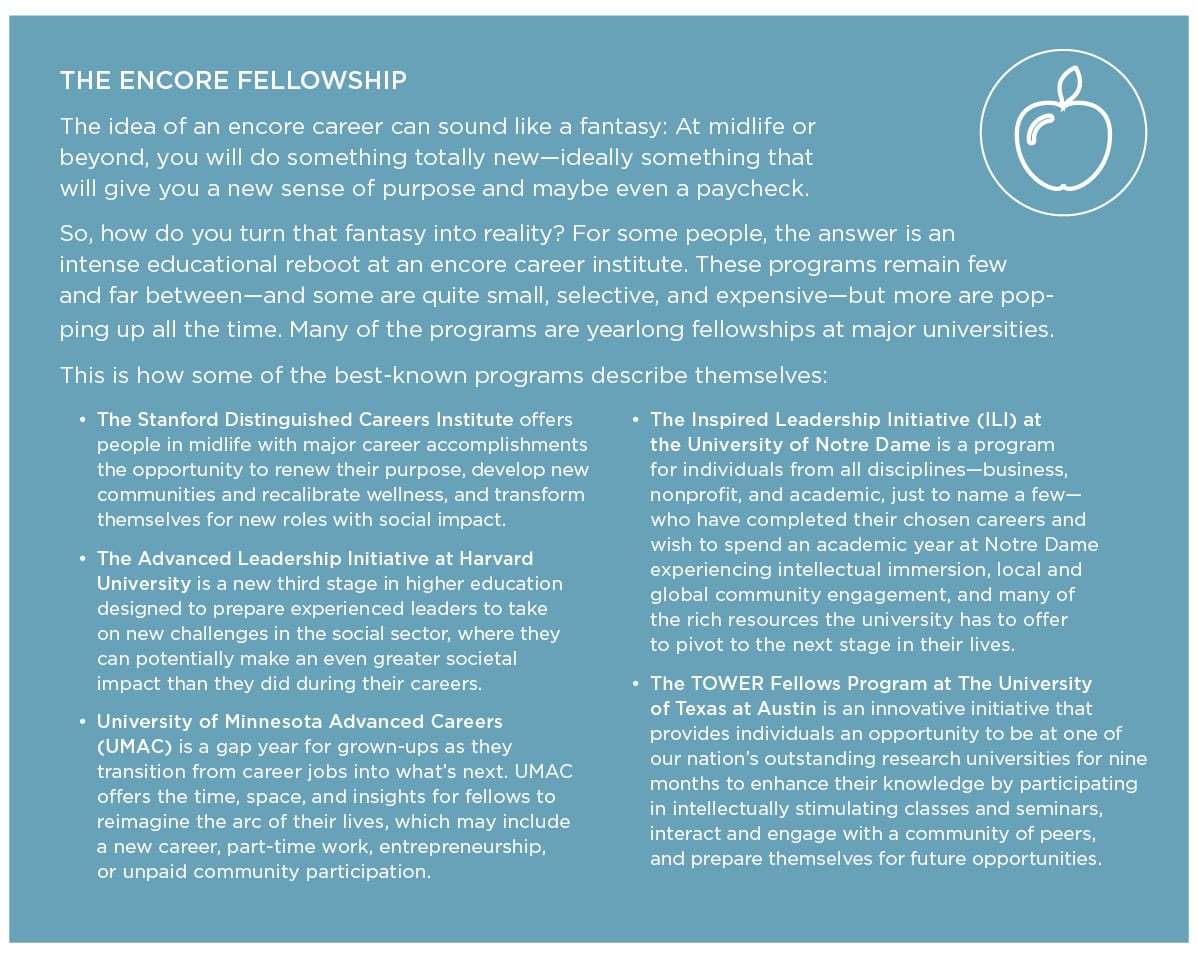
Fulkerson says her fellow attendees were much like the older adults she regularly counsels on encore careers. “These were very energized people trying to figure out what to do next with their lives.”
There are a lot of gray heads in online and brick-and-mortar classrooms these days, and a lot of adults over the age of 50 are asking the same question: What’s next?
Some are seeking new career skills. Many others are pursuing learning for learning’s sake—for intellectual stimulation, a sense of purpose, and, often, social connection.
And educators are responding by throwing out the welcome mat for mature learners in a bigger way than ever before. There are courses online, including the massive open online courses (MOOCs) that some major universities now offer to anyone with an internet connection. There are also plenty of traditional classrooms in colleges, universities, community centers, and elsewhere that welcome older learners.
Want to get a master’s or doctoral degree decades after you last set foot on a campus? Some universities now have support services just for you. Maybe you want to study the history or literature you missed as an undergrad focused on other things. You can find a no-pressure class for that. Or maybe you want to polish your tech skills, prepare for a new leadership role, or unleash your inner entrepreneur. Opportunities abound—in everything from on-campus fellowships to online micro-credential courses.
Still, “We have so much mind-shifting to do,” says Nancy Morrow-Howell, a professor of social policy who directs the Harvey A. Friedman Center for Aging at Washington University in St. Louis. “When we created all our educational institutions, life expectancy was half as long. Now that we live much longer, we can’t stop our formal education at age 22.”
While not all later learning is career-focused, economic forces are driving the change. “We want to work longer, and the workforce needs us longer,” says Morrow-Howell. “But the shift to multigenerational learning is just getting started.”
University for Life
At age 57, Lynne Johnson, of Dallas, Texas, is a proud recent graduate of Washington University’s master’s degree program in social work. She hopes her degree will help her find a job with an organization that assists older adults and their caregivers.
She started her graduate studies at the university’s Brown School in 2015, a couple years after completing a long-delayed bachelor’s degree at another university. In between degrees, she was the primary caregiver for her mother, who has since passed away. Previously, she had a long career in film production and a shorter stint as an English teacher in Taiwan.
Despite her many life experiences and her clear career goals, Johnson says she did not feel entirely welcome when she showed up at graduate school in her early 50s. “I could tell early on—even in the orientation—that the younger students didn’t want anything to do with the older students,” she says. “It was very awkward, and I had a hard time making friends and fitting in.” Some faculty members were unwelcoming as well, she says.
Eventually, she gained confidence and felt more at home, Johnson says. But she saw a need for more support for students like herself. In fall of 2018, shortly after her graduation, she worked with Morrow-Howell to launch a group for students entering the Brown School at age 30 and over. The student group is part of a support program called Next Move.
The university, like many others, is taking broader steps to nurture learners of all ages. In late 2018, it joined the Age-Friendly University Global Network, a group that includes more than 50 universities in the U.S., Canada, Europe, and Asia.
The network is focused, Morrow-Howell says, on helping universities figure out ways to serve people of all ages and promote multigenerational connections.
“Older and younger students will figure out that they are all just people,” she says. “That could go a long way toward reducing ageism—by the young and old, toward the young and old, in workplaces and elsewhere.”
It’s no coincidence that universities are making these changes as alumni and other older adults, including retirees who move to university towns, are asking for more ways to partake in university life, says Holden Thorp, a former Washington University professor of chemistry and medicine, who was the university’s provost and executive vice chancellor for academic affairs for four years. Thorp is now editor-in-chief of the Science family of journals.
“We are definitely seeing some folks wanting to put together their encore careers, but we also are seeing folks who realize that maybe they could have gotten more out of college the first go-around, and they are coming back to do some of the things they wish they had done,” he says.
Traditional college students in their teens and early 20s “do not always think about how rich the intellectual experience in front of them can be,” says Thorp. “But if we can plant the seeds and they come back 30 years later, we’ve done our job.”
Learning for Learning’s Sake
While career and degree-granting programs are welcoming more older learners, some of the most popular courses for mature adults remain those that offer learning for learning’s sake—with no grades or other expectations attached.
That’s the niche served by the Osher Lifelong Learning Institutes, a network of 124 programs hosted by colleges and universities serving 390 towns and cities in all 50 states, says Steve Thaxton, executive director of Osher’s national resource center at Northwestern University, Chicago. He notes that several hundred additional lifelong learning programs, unaffiliated with Osher, operate in other communities. A comprehensive list can be found at osher.net.
While each institute chooses its own offerings, the most popular courses nationwide fall into a few consistent categories year after year, Thaxton says. The list includes history, fine and creative arts, current affairs, literature, religion, philosophy, spirituality, and health and wellness.
The institutes, launched in 2001, “have grown and grown,” Thaxton says. They now serve about 200,000 members nationwide.
One of the largest programs is at Duke University in Durham, North Carolina. The greatest challenge for the program is finding enough classroom space, across four counties, for all the courses attended by its 2,600 members, says Institute Director Chris McLeod. For some popular classes, “we practically have to shoo people out of the classroom, because if we don’t, there will be gridlock in the parking lot” when students arrive for the next session, she says.
McLeod is seeking a new central classroom facility. At the same time, her institute and others like it are weighing the pros and cons of online access to some classes. Such access could expand participation but could also limit the social opportunities that are an important part of the experience, McLeod says. A happy medium might be to set up satellite classrooms—at assisted living centers, for example—where rooms full of people could interact with one another and with an instructor and students in another locale.
In a world where many people want to keep learning longer than they can keep driving, those kinds of accommodations make sense, Thaxton says.
McLeod says there’s also a demand for “more classes around rethinking and reimagining retirement because of longer life spans.” In fact, one of those classes was taught this fall by Fulkerson, the psychologist and career counselor studying online marketing to expand her own options.
According to Fulkerson, “there is a huge unmet need” for helping people past traditional retirement age realize and achieve their full potential. That’s why lifelong learning, for credit or not, for credentials or not, is a growth industry.McLeod agrees. Her members, she says, are “some of the most energetic, highly educated people I’ve met in my life, and they are saying, ‘I’m not done.’”
These stories—based on findings from a study performed by money manager United Income—claim that only 4 percent of retirees are making the financially optimal decision to wait until age 70 to begin receiving benefits. And, while delaying until 70 seems like a stretch, most would benefit by waiting at least until age 65.
As a result of their choices, “they will miss out on a collective $3.4 trillion in benefits before they die,” according to a Bloomberg article on the topic.
That’s a lot of money being left on the table. So much that you must ask yourself: Why is this happening?
As you would expect, that question has many potential answers—some practical and some more esoteric.
Practical Explanations
Practically speaking, there are many partial answers. For example, some of these retirees may not have had access to good software, tools, or advice to help them make this important decision, so they made the only one that made sense to them.
According to Federal Reserve data, the median and most common retirement age in the United States is 62. You know what else it is? It’s also the minimum age at which you can start collecting Social Security benefits.
Arguably, the reduced benefit available at the early eligibility age of 62 is a financial incentive to file. In other words, getting something today—even at a reduced rate—is better than what I could have received yesterday.
This urgency has been fueled by Social Security staffers who have inappropriately told people who make benefit inquiries to “Take your benefits because you could die tomorrow,” says Laurence Kotlikoff, professor of economics at Boston University and author of Get What’s Yours: The Secrets to Maxing Out Your Social Security.
And, of course, with the negative press we periodically see about benefit cuts or the solvency of the Social Security trust fund, it is understandable that some fraction of filers may want to tap into their benefits early to make sure they get out what they put in—even if they aren’t optimizing.
No doubt there is a kernel of truth in these explanations, but that doesn’t explain the overwhelming miscalculation that Social Security filers repeatedly make.
The fact is: There are several aspects of the Social Security filing decision that simply confound the human brain. These behavioral biases, as they are known, can render humans unable to make optimal—or sometimes even OK—decisions about their financial lives. Arguably, there could be numerous biases negatively influencing the Social Security filing decision, but let’s focus on two.
Immediate Gratification
The first of these biases is called present bias. Present bias is the idea that an individual will place greater value on something received in the present moment, rather than waiting to receive it in the future. It suggests that, given the choice between a payoff today and a payoff in the future, we tend to choose the payoff now—otherwise known as immediate gratification. This is true even for decisions that our future selves may regret.
In a nutshell, we see the future self we are delaying gratification for as a separate person from our current self, making the decision in question a choice between doing something for ourselves today or doing something for a stranger tomorrow.
In the case of Social Security, present bias causes millions of Americans to value—and therefore file to receive—benefits today versus benefits later, despite the significantly higher payouts they’d receive if they waited. Of course, present bias is not limited to the Social Security decision. It is—pardon the expression—ever present in our lives.
Present bias is why we splurge on a big vacation or a lavish purchase today and fail to start saving. It’s why we claim we’ll save more later, after we get a raise or bonus, but don’t. It’s why we eagerly commit to dieting or a new exercise regime—so long as we get to start it tomorrow.
We see the certain and immediate costs to these choices and weigh them against murky benefits in the distant future. Immediate gratification wins almost every time.
Fuzzy Math
The other behavioral bias worth mentioning is called exponential-growth bias. Exponential-growth bias is the tendency to undervalue the effects of compound interest, leading to the underestimation of future values. Because we are very bad at these calculations, our underestimation can be massive.
Victor Stango and Jonathan Zinman from Dartmouth College wrote about exponential-growth bias in their 2007 paper, “Fuzzy Math in Household Finance: A Practical Guide.” They point out that exponential-growth bias is relevant to household finances in two ways. Unchecked, exponential-growth bias means that people will get the future value of savings or investments wrong, especially “when the opportunities are relatively long-term and/or high-yielding,” say Stango and Zinman. “They underestimate returns because they underestimate how quickly interest compounds.”
Exponential-growth bias also leads to underestimation of interest costs on borrowing. “This problem is the mirror image of understanding compound interest,” say Stango and Zinman. The net result is that households with a strong exponential-growth bias tend to save less and borrow more—a double-edged sword of bad financial behaviors.
Back to Social Security. Exponential-growth bias is part of why filers are more likely to file for benefits before full retirement age. It causes them to undervalue the benefits of waiting. Further, because many people are cash poor, “they can’t wait until age 70 to collect their retirement benefit when they’d be roughly 70 percent higher, after inflation, than if they started claiming at age 62,” says Social Security expert Laurence Kotlikoff. They can’t grasp the real value of waiting.
The fuzzy math challenge of Social Security is further complicated by the fact that Social Security pays an inflation-adjusted income until you die—and most filers are not capable of valuing the longevity insurance and inflation protection that’s built into benefits. But that’s a story for another day.
Of course, all is not lost. You can, in fact, overcome the challenges of our flawed human wiring when it comes to maximizing Social Security benefits. What can you do?
Here are a few suggestions:
- Estimate your benefits. Through the Social Security Administration’s website at ssa.gov, you can get a personal benefit statement that takes into account your earnings over the years. From there you can model the impact of taking benefits before and after your full retirement age—and clearly see the value of waiting.
- Plan to maximize benefits. Not everyone can afford to delay taking benefits until age 70. A comprehensive retirement plan that looks at your expected retirement spending and potential sources of income can help you understand if it’s possible to delay or when you’ll need to start taking Social Security benefits.
- Shock test your plan. As the saying goes, “No plan survives contact with the enemy.” Make sure your plan includes extreme scenarios, including living to 100 (or older!), a significant market sell-off the year you retire, a Social Security benefit cut, and a sustained increase in spending—whatever you need to test to make sure you’re going to sleep at night.
- Reserve the right to reassess. Retirement is not a set-it-and-forget-it endeavor. It’s an iterative process. Update your plan periodically—every three to five years or whenever you’ve experienced a significant change—and be prepared to adapt. Sustained good or bad markets, a sudden change of health status, or sale of property are all excellent reasons to loop back and reassess your plan.
If you’re reading this, chances are good you have already taken at least one big step and hired a financial advisor. A financial advisor will take the time to understand your individual situation and create a retirement plan and investment strategy tailored to your specific needs, goals, and risk tolerance. As importantly, an advisor can help you keep your emotions and biases in check so that you stay on course.
Erikson says the drive to contribute to another’s positive development using the knowledge and wisdom you’ve accumulated over the years leads to successful completion of the generativity stage and the later “integrity” stage of life in later adulthood, when you look back and review your contributions. His research shows that those who don’t reach out to others and give back risk feeling disconnected and may regret missed opportunities.
One way we can leave a lasting legacy is by mentoring others. Mentoring can occur in all types of environments—anytime and anywhere. Aside from the seminal task of parenting, workplace mentoring can help fulfill Erikson’s generativity task during middle adulthood. Workplace mentoring programs may sustain and improve companies, in part, by powerful effects on both mentor and mentee. For those in retirement, post-career mentoring can lead you in new directions for a more satisfying next chapter.
The Power of Workplace Mentoring
Companies are eager to transmit knowledge from experienced workers to new hires. By teaching young employees about the successes and failures that they have experienced, mentors play a vital role in the making of future leaders. Most C-suite executives—75 percent—say that mentoring helped to propel them to leadership positions.1
Mentoring has many other positive attributes that impact the bottom line. Studies show that mentoring programs help companies recruit quality candidates, increase employee engagement, and boost job retention. When an employee has a mentor, he or she is less likely to be looking at other job options.
Mentoring programs also help increase diversity. Research shows that when managers are paired with mentees of a different race or gender, getting to know the person helps break down stereotypes or bias; the mentor becomes a champion of the mentee through the new relationship.
Those are several good reasons that more than 70 percent of Fortune 500 companies have some variation of a mentoring program, and about 25 percent of small companies do, too.2
Experts say there’s no one best mentoring program; the goals of the company, the culture, and even new technologies, all help shape different types of mentoring approaches.
Essential Advice for Mentors
Top corporate mentoring programs don’t get that way by accident; sponsoring companies evaluate their programs and listen to feedback. First Round, a venture capital firm that creates initial stage funding of tech companies, issued a call for mentees and mentors and received an overwhelming response from both.
The company structured its mentoring approach so that each mentor-mentee pair met every other week for one quarter. The mentees developed an agenda and shared it prior to their meetings, and First Round surveyed how mentees were applying their learning—all good workplace mentoring practices.
First Round then evaluated 100 matches to find what qualities make the most successful mentor-mentee matches and distilled the knowledge into a piece titled “We Studied 100 Mentor-Mentee Matches—Here’s What Makes Mentorship Work.” Here is what they found:
- It’s not just business. Successful mentor-mentee pairs use their time together to form personal connections. Find out who each other is outside of work. Ask about favorite activities, hopes and dreams, and family. This forms the beginnings of real relationships.
- Transparency and self-disclosure. A seminal piece of advice for mentors is to be transparent. When you share a story about a time a project didn’t work out the way you planned or something you regret and why, you’re showing vulnerability. Your mentee is more likely to feel that he or she can bring a problem to you without fear of criticism.
- The ability to listen. Good mentors are also good listeners. Meet in a conference room or nearby coffee shop for more privacy. Mute your phone, and pay attention.
Think about the people in your orbit. To whom have you gone for advice? Most likely, it’s the people who sat back and listened without judgment—who didn’t jump in immediately with all the answers or counterpoints. A poetic essay by Brenda Ueland, “Tell Me More: On the Fine Art of Listening,” points out that simply being able to talk out a problem can help clarify what needs to happen next. Being heard is an important gift you can give your mentee.
Benefits for Both of You
Mentoring not only aids the mentee’s growth and development, it also provides important benefits for the mentor. If your mentee is younger and recently out of school, he or she may show you the latest technology or reveal new practices in your industry.
Mentoring also has the potential to develop leadership skills. A Sun Microsystems study of employee career progress found that those who mentored others were six times more likely to be promoted than employees who didn’t mentor.3
Mentoring also has powerful psychological benefits, both in the workplace and otherwise. When mentoring, you’re giving of yourself to others and the act has a boomerang effect. When you help guide someone’s growth and development, you gain a sense of fulfillment, purpose, and achievement. Research shows that helping others can cause physiological changes in your brain related to feelings of happiness, followed by a sense of well-being, and may stimulate neurochemicals involved in experiencing a reward.
Beyond the Workplace
If you’re approaching retirement, have you thought about life after you’re no longer in the 9-to-5 world? Experts say it’s important to have a plan. Going from operating on all cylinders to a full stop can lead you to question your purpose. Retirement offers tremendous freedom to make a truly meaningful impact in the lives of others.
You don’t need to be a professional expert to be a great mentor. You just need to be able to answer basic questions or know where to find the answers.
There are a multitude of different mentoring opportunities around each and every one of us. For example, if you relate to children well, you could be a welcome addition to a mentoring program helping at-risk youth. In fact, analyses of programs mentoring at-risk youth show that children who have a consistent relationship with a mentor are 52 percent less likely than their peers to skip a day of school and 37 percent less likely to skip a class.4
Another option, faith-based mentoring, is very common. Also known as spiritual mentoring, it is largely about modeling a mature life built on the values of your faith and being there for the mentee when questions arise.
Athletic coaches are in an advantageous position to become mentors. A few minutes during a water break or a quick walk-up to the athlete while heading to the locker room can bring about surprising results. Players become comfortable around coaches and learn to initiate such mentoring moments on their own.
The bottom line is, mentoring opportunities are everywhere. If you’re knowledgeable about things like budgeting from paycheck to paycheck, obtaining employment or improving employment situations, improving your level of education, improving homemaking skills, or establishing a network of people who are reliable, you have plenty of valuable insight that you could pass on to another person through mentoring.
To quote the website of Trusted Mentor, a nonprofit organization in Indianapolis, Indiana, “Whether you are a business professional or formerly homeless, your knowledge and life experiences can help one of our mentees make the positive changes they desire for a more successful future.”
If you want to help an individual who is seeking to be supported by a mentor, you can visit mentoring.org and search the Mentoring Connector database for a variety of programs in your community and connect with them directly about becoming a mentor.
Mentoring can make a lasting difference in someone else’s life. What do you want your legacy to be? Mentoring may play a central role.
1 George, Phil, “Your Next Must-Have Job Benefit: A Mentoring Program,” Recruiter, 2017
2 Jones, Mel, “Why Can’t Companies Get Mentorship Programs Right?” The Atlantic, 2017
3 Richards, Kelli, “The 4 Most Important Reasons You Need to Become a Mentor,” Inc., 2014
4 “Mentoring impact,” Mentor: The National Mentoring Partnership, 2019
In today’s tight labor market, retirement plan sponsors across industries are battling it out for recruitment value, retention of current employees, and a general sense of goodwill among current retirement plan participants.
So how can plan sponsors know if their plans are headed into this competition with a leg up or in need of improvement?
According to James “Jan” Harper, senior vice president and chief human resources officer at Tidelands Health, it’s about setting goals, measuring against those goals, and making that process a habit.
Take Your Plan’s Pulse
Measuring a plan will open plan sponsor’s eyes to a wealth of data that can be used to assess a plan’s health. Metrics like plan utilization, average contribution rate, and diversification of investments within retirement accounts are invaluable inputs for plan providers looking to maximize the value derived from their offerings.
Useful measurements that detail the current state of its plans give Tidelands Health clues on where to focus attention when looking to boost plan performance, according to Harper. Success metrics, such as participation rate, contribution rate, and diversification of account assets are “provided [by our recordkeeper] on a quarterly basis at a minimum,” says Harper.
A metric Harper takes very seriously—and perhaps the most popular metric to gauge plan success—is participation rate. A plan’s participation rate is a good measure of the percentage of their workforce that is actively saving for retirement.
Plan sponsors can calculate participation rate by dividing the number of employees making payroll deduction contributions to the plan by the number of employees eligible to contribute. For example, if an employer has 1,000 eligible employees and 700 are making contributions to the plan, the plan’s participation rate is 70 percent.
Contribution rate can help employers measure plan effectiveness in a different way. By tracking the percentage of income employees dedicate to their retirement plans, plan sponsors can generally measure whether or not their employees are saving enough for their retirement.
Diversification of account assets measures how participant balances are distributed among investment asset classes, such as stocks, bonds, and cash equivalents. This is another important measure because it helps sponsors gauge participants’ general level of investment savvy and how likely they are to react to inevitable market swings.
Looking at Success Ratios
While all of these metrics provide a baseline indication of how well a plan is performing, none of them capture the big-picture view most plan sponsors are trying to see: what percentage of plan participants are on track to meet the suggested income replacement ratio in retirement. This is perhaps the single most insightful piece of data available to plan sponsors.
This calculation takes each participant’s current balance, age, savings rate, assumed rate of return, and retirement age, and projects an account balance at normal retirement age (commonly 65). More complex calculations add the ability for participants to include other retirement assets and retirement income streams.
The calculation then projects the retirement income stream that the account would generate given a set of assumptions, adds in expected Social Security benefits, and provides the result as a percentage of pre-retirement income replaced in retirement. In many cases, like that of Tidelands Health, retirement income replacement ratio calculations are completed by the plan’s recordkeeper.
“Plan sponsors can take this information and compare it with a plan-level goal that represents the income necessary to maintain the same standard of living in retirement as enjoyed while working, typically between 70 percent and 80 percent of an individual’s final year’s salary,” says CAPTRUST Defined Contribution Practice Leader Scott Matheson.
However, Matheson explains that there are a number of challenges in determining the exact percentage of participants who are on track for meeting their retirement income replacement savings goals. “Because replacement income comes from Social Security, the current retirement plan, retirement plans from previous employers, and other savings, plan sponsors cannot capture all potential replacement income for every participant,” he says.
If a recordkeeper does not have all the necessary data to complete the calculation, the plan sponsor can provide a file with the census information to the recordkeeper to generate the projections.
“Because of the unpredictability of financial markets, a recordkeeper should run multiple iterations of these projections,” says Matheson. “Different investment return scenarios, using tools like Monte Carlo simulations, provide a range of potential outcomes for each participant.”
What if plan sponsors aren’t happy with what they find? The metrics provide a GPS to direct their attention and budgets.
Plan sponsors concerned about plan participation rate should consider implementing automatic enrollment. If low plan contribution rates are an area of concern, roll out a new automatic annual increase program.
Or get creative like Tidelands Health. According to Harper, as part of Tidelands Health’s Wellness Program, participants are required, as a free benefit, to contact an appointed financial counselor and complete a retirement needs assessment on a biannual basis. Harper explains that participants in the health plans who fail to do so will forgo up to $1,000 in credits that would otherwise be available to the participant to pay out-of-pocket healthcare expenses such as deductibles, copays, co-insurance, etc.
A Checkup from the Neck Up
How employees feel about their retirement readiness and the benefits offered to them matters, and knowing what employees want can go a long way toward creating an outstanding compensation and benefits package—a tool that can both attract and retain workers.
A full three-quarters of Americans are only “somewhat confident” or are “not confident at all” that they will be financially prepared for retirement, according to a recent PLANSPONSOR article. And, according to U.S. News & World Report, few employers evaluate employee satisfaction with their retirement benefits. Only 34 percent of plan sponsors have conducted an employee survey to gauge how satisfied employees are with the education and support they receive about their retirement plan.
So, what can plan sponsors do to better understand how participants feel about their retirement readiness?
Ask them.
Ask them if they are happy with the benefits. Ask them if they are making use of them, or if they need some additional perks to sweeten the deal. Ask them how confident they feel about their financial preparedness for retirement. Ask them what’s working and what’s not working about the plan offering.
This type of qualitative research approach allows plan sponsors to gain a deeper grasp of the challenges retirees face every day. This data is observed and recorded through the methods of observation, one-to-one interviews, focus groups, and surveys.
A 360-degree survey administered by a third-party vendor can be useful for gauging employee satisfaction with the benefits package and for gathering general feedback. However, it is also possible to use a low-cost survey resource, such as Survey Monkey, to develop a quick and easy retirement confidence survey for employees.
What’s important is not how plan sponsors obtain this essential participant data, but that it is collected and interpreted in a way that can help elevate the benefits offering. Of course, if you’re going to ask the questions, you should also be prepared to act on at least some of the feedback.
Set Your Target
Metrics gleaned from an employee survey are helpful by themselves. They provide plan sponsors with a baseline against which they can measure progress or identify trends—positive or negative. But what do good or bad metrics look like for a particular employee population, industry, or plan design? What are the right targets to shoot for?
Setting the right goals or benchmarks doesn’t have to be guesswork. Once data on the plan’s leading indicators, outcomes, and qualitative measures has been gathered, plan sponsors can compare the plan to plans of similar sizes across their industries on a regular basis.
“This is an area where plan sponsors should lean on their recordkeepers or advisors to give them broad-based industry conventions or benchmarks,” says Matheson. “You can work with them to find out what your competitors’ plans look like based on the metrics that matter to you and the subject matter experts you surround yourself with.”
Tidelands Health sets goals based on what they are hearing and seeing from their industry peers, according to Harper. “When I have the ability to sit among my contemporaries in a national audience, and I hear that the organizations I respect say that their participation rates are 90 percent, I set my sights on a 90 percent participation rate for our plans,” he says.
Many plans determine metric goals based on information provided through the Plan Sponsor Council of America (PSCA), a nonprofit association that provides services, best practice information, and advocacy to defined contribution plan sponsors. The PSCA’s 61st Annual Survey of Profit Sharing and 401(k) Plans reports on the 2018 plan-year experience of more than 500 plans.
Another great reference when setting plan goals is asset manager Vanguard’s How America Saves 2019. Here, you will find data on more than 1,900 defined contribution retirement plans and more than 5 million participants. In this 18th edition of How America Saves, Vanguard updates its analysis of defined contribution plans and participant behavior based on 2018 recordkeeping data. Specifically, plan sponsors will find retirement plan benchmarks and data supplements such as average participation rates, median account balances, typical asset allocations, and much more.
These reports serve as valuable reference tools that will prove very useful as plan sponsors look to measure and benchmark their plans.
Some plan sponsors, like Tidelands Health, utilize services offered by a recordkeeper to get an idea of current plan success ratios. Recordkeepers have access to information on how well—or how poorly—participants within other plans are prepared for post-retirement income needs. According to Matheson, obtaining and interpreting this information is critical to setting appropriate success factor goals for your plan.
In addition to setting quantitative goals, plan sponsors are also setting qualitative goals. “A good starting point for setting goals around qualitative targets is the Employee Job Satisfaction and Engagement research report developed by the Society for Human Resource Management (SHRM),” says Matheson. The report covers qualitative benchmarks for stacking up against a retirement plan, such as percentage of employees satisfied with their benefits, how employees rank importance and satisfaction with benefit aspects, what kinds of benefits retain employees, plus loads more research conducted by SHRM.
Measuring Is Not One and Done
Determining the frequency, scope, and specific metrics of these checkups is essential. Gathering plan metrics on a regular basis provides plan sponsors with a way to see how their retirement plans stack up against others within their industry so they can focus their attention on plan design tweaks, promotion opportunities, or employee groups who are failing to take advantage of this important benefit.
Getting started is what’s important. Plan sponsors should understand that their methods and measuring criteria can—and should—evolve over time as plans and goals change. For plan sponsors just beginning this journey, focusing on baseline metrics like participation rate, contribution rate, and diversification of account assets provides a solid step in the right direction. Over time, they may want to consider exploring different areas of measurement to identify new opportunities for improvement or uncover positive and negative trends.Having an effective retirement savings program can come with real rewards for institutions that are able to stay on the right side of metrics that support their goals. While each case is different, there is no doubt that measuring gives plan sponsors key information in making their retirement benefits as competitive as possible.
The millennial generation is now the country’s largest, comprising one in three American adults. In the next decade, it could also become one of the richest, as millennials begin to inherit more than $68 trillion from their baby boomer parents. This marks the largest generational transfer wealth in history.
For nonprofits, millennials represent a tremendous opportunity. And organizations that do the work now to understand this demographic group may be able to better engage them as lifelong partners and donors. In this article, we’ll explore some key characteristics of millennial donors and how nonprofits might shift engagement strategies to reach this unique group.
Let Them Get Their Hands Dirty
At this stage of their lives, millennials are more likely than other generations to donate time instead of money. With lower pay and more student debt than previous generations, millennials are more likely to report limited disposable income.
“They’re dealing with a lot of competing financial priorities, but that doesn’t mean they don’t want to help,” says CAPTRUST Director of the Institutional Portfolios Practice Grant Verhaeghe. “Creating a sense of ownership for millennials around a fundraising activity can be the first building block of an ongoing relationship.”
One positive experience can create a lifelong connection. Therefore, nonprofits might consider offering in-person or virtual fundraising events to help donors feel more deeply connected to their organizations. Charitable races, exercise classes, community improvement days, litter pick-ups, and food- or drink tasting events are a few common examples.
“Millennials tend to enjoy hands-on volunteer experiences, participating in events that allow them simultaneously to give time and raise money in support of their favorite causes,” says Verhaeghe.
One well-known example of an experience-based fundraising challenge was the 2014 water-bucket challenge that raised money for the ALS Association. As part of the challenge, more than 17 million people, including Bill Gates and former President George W. Bush, dumped ice-cold water over themselves. The ALS Ice Bucket Challenge raised $115 million—twice as much as the charity raises in a typical year.
However, raising a windfall that’s equal to double your organization’s annual budget, like the ALS Association did, can present its own unique challenges. For instance, the ALS Association reported running a significant deficit five years after, as they spent down the burst of money from the Ice Bucket Challenge.
The Ice Bucket Challenge also tapped into millennial social media use. Promoted solely through social media platforms, the challenge went viral, with more than 17 million people posting videos online.
Be Tech Savvy
Although Gen Z may give them a run for the money, millennials are still one of the biggest consumer groups of social media. According to The Millennial Impact, 90 percent of millennials use one or more forms of social media daily, and 51 percent use it to engage in causes they care about. This generation also likes to use an array of digital platforms to reach out to their personal networks and ask for help in fundraising. This includes Facebook, Quora, Twitter, Instagram, and LinkedIn, to name just a few.
“By engaging millennials online and through digital media platforms, nonprofits can connect with a much larger network,” says Eric Bailey, a CAPTRUST financial advisor specializing in institutional fiduciary services for endowments and foundations. “This generation uses social media to amplify their voices on issues that matter to them, and nonprofits should be taking full advantage of that.”
As Figure One shows, almost half of millennials who have given charitably enjoy promoting nonprofit organizations through their social media accounts. Additionally, millennials are twice as likely as baby boomers to follow a cause or charity on social media. And they’re nearly twice as likely to see social media platforms as an acceptable way to ask for donations.
Figure One: Social Media Donor Engagement by Generation
Source: “The Next Generation of American Giving,” Blackbaud Institute, 2018
Peer-to-peer fundraising is another popular technology used by many nonprofit organizations. “It’s a great way to attract new donors and reach new networks of people,” says Bailey. This method of fundraising is a multitiered approach through which individual fundraisers set up a personal fundraising page to accept donations, which are then received by your nonprofit.
“[Individual fundraisers] essentially have their own websites,” says Brad Davis, executive director at the WakeMed Foundation, which uses peer-to-peer fundraising throughout the year. “We give them sort of a template and some boilerplate stuff, and then they personalize it.”
This strategy makes use of a donors’ existing social network, encouraging supporters to collect donations from their peers, friends, coworkers, family members, and neighbors on behalf of the nonprofit. “Peer-to-peer campaigns are effective because they build on relationships, make use of your existing donor base to reach new audiences, and help build social proof,” says Bailey. “Nonprofits absolutely need to use digital platforms to make connections with millennials and to clearly communicate their mission and needs,” says Bailey. “But that’s certainly not the only way to meaningfully connect with millennials. We’re also finding that millennials are active participants in corporate giving programs.”
Get Them Where They Work
Of working charitable givers, more millennials than any other generation are interested in workplace giving, and 40 percent have already participated in a workplace fundraiser, according to the Blackbaud Institute. These facts speak to an emerging opportunity for nonprofits to reach present and future donors where they are.
Workplace donations dramatically reduce administrative costs for charities. And automatic payroll deductions are one of the few opportunities for your organization to secure an ongoing, predictable source of revenue. In fact, almost half of survey respondents identified workplace giving as a major growth strategy for their organization, according to Nonprofits Source.
Davis says charitable payroll deductions have been a successful strategy for the WakeMed Foundation in Raleigh, North Carolina. “We raised about $800,000 last year from WakeMed employees at all levels, and they pay through payroll deductions, which is really cool,” he says.
However, according to Bailey, the options for employee giving may be limited to a preset list that would vary by company. The challenge for each nonprofit is figuring out how to be included on those lists of eligible charities.
Nonprofits can get started by joining one or all the organizations that set up payroll deduction giving campaigns at corporations. Some of these organizations are America’s Charities, EarthShare, and Community Shares USA.
Many corporations also offer paid time off for employees to volunteer, offering yet another means for nonprofits to connect with millennial givers. Bailey recommends nonprofits reach out to individual corporations’ human resources departments to explore partnership opportunities.
Of course, there are a variety of ways nonprofits can team up with corporations to effectively structure an employee volunteer program, including day-of-service events, skills giving, and pro bono services. But organizations who want to engage millennials successfully and consistently in workplace giving or volunteering will also need a reputation of transparency and integrity.
Be Crystal Clear
Millennials have higher expectations for organizations whose missions are to do good. And 60 percent say they are more inclined to give if they can see the impact of their gift.
“Today, people want to know more about a nonprofit’s goals, its impact, and the outcomes it produced. Donors want access to detailed financial reporting, too,” says Verhaeghe. “Millennials want to know about the differences a charitable organization is making before they contribute to its cause,” he adds.
Trust is a big deal to today’s donors. If a nonprofit organization doesn’t live up to certain standards of transparency, it will receive less in contributions than organizations that proactively provide data to the public.
It should come as no surprise that the characteristics of true nonprofit transparency are important to all charitable givers, not just millennials. For a deeper dive into the importance of transparency, see our corresponding article, “Transparent Reputations and Nonprofit Organizations.”
Nonprofits that evolve alongside—and effectively engage—the millennial generation will reap the benefits. Like their baby boomer parents, millennials are charitably inclined, and they believe strongly that they can change the world. But this can only happen if nonprofits them where they are—online, at work, in-person, and with transparency.