Summit Fever: A Lesson in Portfolio Rebalancing
By Jim Underwood and Chris Goff
In his best-selling book Into Thin Air, Jon Krakauer provides a firsthand account of the disastrous Mount Everest expedition that claimed the lives of eight climbers on May 10, 1996.
Krakauer, a journalist and mountaineer, was part of a commercial expedition led by renowned guide Rob Hall. The book chronicles the extensive planning and difficult decisions their group of guides and climbers was forced to face in an environment where even small mistakes can have fatal consequences.
One of the book’s most important lessons is the critical role of turnaround times. In high-altitude mountaineering, a turnaround time is a predetermined hour by which climbers must stop hiking up and start hiking down, regardless of how close they are to the summit. These times exist because the descent is often more dangerous than the ascent.
Turnaround times are not designed for moments when the decision is easy. Rather, they are put in place in advance for when emotions are strongest. Mountaineers call these emotions summit fever.
Summit fever tends to set in when the desire to reach the top becomes so powerful it overwhelms all rational judgment. After investing significant sweat, time, planning, emotion, and money in the climb, turning back can feel like clear defeat, even when conditions obviously warrant it.
Before the summit attempt on May 10, Hall and other guides established a turnaround time of 2 p.m. But numerous delays put the group behind schedule. With the summit in sight, many climbers and guides chose to continue upward even after 2 p.m.
The consequences were catastrophic.
Many in the group remained on the mountain late into the day and were caught by a severe storm during their descent. Some were lost, others exhausted and stranded above 26,000 feet—in the death zone, where there is so little oxygen the human body simply cannot survive for long.
The people who perished on Everest that day were not reckless amateurs attempting something beyond their knowledge or capabilities. They were experienced mountaineers who had successfully navigated countless challenges to position themselves within reach of their ambitious goal.
The tragedy occurred not because of ineptitude but because past successes changed their decision-making protocol. The closer they came to the summit, the easier it was to rationalize abandoning the rules designed to protect them.
Investigators later identified many contributing factors, but one lesson stands out: The greatest danger did not emerge due to physical failure, as one might assume. It emerged because they
made an emotion-based decision when success was in sight.
By disregarding their own decision-making rules, the mountaineers exposed themselves to unnecessary and unescapable risk.
The Investor’s Version of Summit Fever
Like Everest climbers, investors create strategic plans intended to guide their financial decision-making. These plans are completed with calm minds, clear eyes, and rational expectations. In conversations with their financial advisors, they establish their target asset allocations, define acceptable levels of risk, and identify the goals their portfolios are intended to support.
The true test comes when emotions are high.
Most investors assume the greatest threat to their financial plan is a falling market. As investment managers, we have seen the emotional reactions that market declines can create. Yet we have also seen the inverse: Some of the most damaging investment decisions occur not during descents but when markets are rising.
Like climbers approaching a summit, investors can become increasingly confident as success accumulates. Strong returns feel like validation, and risk appears manageable because recent experience has been positive.
These investors gradually—and perhaps unconsciously—shift their focus from the probability to the magnitude of success. The rules established at the beginning of the journey begin to feel less necessary.
This is investing’s version of summit fever. While emotional decisions on the side of a mountain can pose grave physical risks, emotional investment decisions during a roaring bull market can have dire financial consequences.
Warren Buffett captured the importance of emotional discipline in investing when he wrote the following, in The Essays of Warren Buffett: Lessons for Corporate America:
“To invest successfully over a lifetime does not require a stratospheric IQ, unusual business insights, or inside information. What’s needed is a sound intellectual framework for making decisions and the ability to keep emotions from corroding that framework.”
Portfolio Rebalancing: The Investor’s Turnaround Time
One of the clearest expressions of disciplined investing is portfolio rebalancing.
When investors hear the term rebalancing, they often think of it as a mechanical exercise—one too simple to actually matter. A portfolio drifts from its target allocation, positions are adjusted to restore those targets, and time goes on.
While technically accurate, this description misses the deeper reason why rebalancing matters. Its value lies not in the transactions themselves but in the discipline that rebalancing imposes.
Consider the connection to Everest. A turnaround time exists because climbers cannot always rely on themselves to make rational decisions near the summit. The turnaround rule recognizes human nature and creates a framework for clear decision-making before emotions become overwhelming.
Rebalancing does the same thing for investors. As markets move, portfolios drift. Strongly performing assets gradually occupy larger portions of the portfolio, while underperforming assets become smaller allocations. Left unchecked, the portfolio increasingly reflects recent market performance rather than the investor’s original risk objectives.
Assume that, on December 31, 2022, an investor decided the following portfolio, described in Figure 1, best aligned with their personal risk-tolerance profile and long-term financial goals.
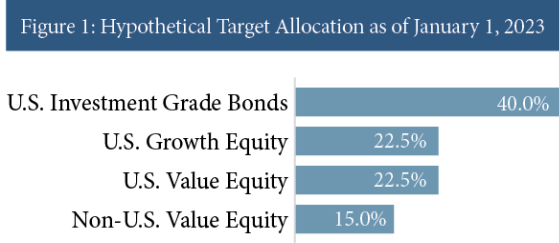
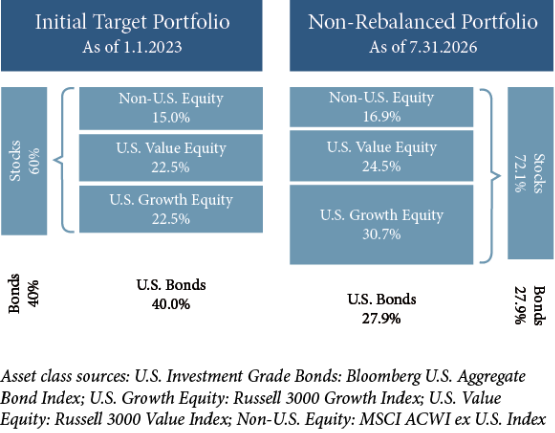
From January 1, 2023, through July 31, 2026, the S&P 500 Index nearly doubled in value, driven primarily by a small segment of mega-cap growth companies. As shown in Figure 2, a portfolio designed to hold a growth-and-value balanced 60 percent equities and 40 percent bonds, if left unmanaged, would now hold 72.1 percent equities and only 27.9 percent bonds, with a significant skew toward growth.
That drift is more than a mathematical observation. It is a behavioral challenge, especially when staying disciplined may require a person to realize taxable investment gains.
Figure 2: Hypothetical Portfolio Allocation Changes Over Time, January 1, 2023, through July 31, 2026
The past several years have truly been a remarkable period to have invested in equity markets, and today’s artificial intelligence–fueled upward momentum seems unrelenting. Choosing not to rebalance over the last few years could have resulted in a higher portfolio value. But good decisions and good outcomes are not always synonymous.
A climber who obeys a turnaround time may descend safely while watching their colleague step out onto the summit. But that does not mean their disciplined decision-making was wrong. It simply means short-term outcomes are influenced by multiple factors far beyond our control.
The quality of any decision should be evaluated based on the information available at the time and whether it aligned with the long-term strategy.
The strength of the current equity bull market has overwhelmed every bear-market narrative. It is easy for investors to let their guards down. However, history has often shown that discipline matters most when it feels least necessary.
As Howard Marks wrote in The Most Important Thing, “resisting the seductive power of cycles and trends is one of the most difficult aspects of successful investing.” The challenge is not understanding the concept. The challenge is implementing it consistently. Discipline is often easier to practice in theory than in life.
The purpose of rebalancing is not to predict market declines, identify the next winning investment, or maximize short-term returns. Rather, in many respects, rebalancing is an exercise in humility. More broadly, disciplined portfolio management is less about predicting storms than respecting their inevitability. Storms, after all, are natural and expected.
Beyond the Summit
The lessons from Everest extend beyond both mountaineering and investing. They remind us that long-term success in any endeavor often depends less on intelligence or ambition than on the ability to follow a well-considered process when emotions are strongest.
Markets, like mountains, have a way of testing conviction at precisely the moments when discipline feels most difficult.
Investors can draw three important takeaways from the metaphor.
- Establish decision rules before emotions become involved. Whether through target asset allocations, rebalancing thresholds, or spending policies, the best safeguards are those created during periods
of objectivity. - Evaluate decisions based on process rather than outcome. A sound decision can occasionally produce an unfavorable result, just as an imprudent decision can sometimes be rewarded. Over time, however, disciplined processes tend to prevail.
- Remember that investing is not a series of isolated decisions but a lifelong journey. The objective is not to maximize returns in every market cycle. It is to compound wealth consistently while avoiding mistakes that can permanently impair long-term goals.
The investors most likely to reach their destination are not necessarily those who chase every opportunity or push furthest during favorable conditions. They are the ones who maintain the discipline to follow their framework, especially when success tempts them to abandon it.
Disclosure: Hypothetical allocations are for illustrative and educational purposes only.
Index Definitions:
- Bloomberg U.S. Aggregate Bond Index measures the performance of the investment grade, U.S. dollar-denominated, fixed-rate taxable bond market. It includes publicly offered U.S. Treasuries, government-related securities, corporate bonds, mortgage-backed securities (MBS), asset-backed securities (ABS), and commercial mortgage-backed securities (CMBS) available for investment in the U.S.
- Russell 3000 Growth Index measures the performance of the growth segment of the broad U.S. equity market. It includes those Russell 3000 companies with relatively higher price-to-book ratios, higher forecast medium-term (2 years) growth, and higher sales-per-share historical growth (5 years).
- Russell 3000 Value Index measures the performance of the value segment of the broad U.S. equity market. It includes those Russell 3000 companies with relatively lower price-to-book ratios, lower forecast medium-term (2 years) growth, and lower sales-per-share historical growth (5 years).
- MSCI All Country World Index (ACWI) measures large and mid-cap stocks across Developed Markets and Emerging Markets, covering approximately 85 percent of domestic and global investable opportunities.