It’s a childhood memory many Americans share: that feeling of walking into class to discover there’s a substitute teacher. There’s a little shock, followed by a lift of reprieve. Maybe the quiz is canceled. Maybe you’ll get away with not having finished your homework. Or maybe you’ll get to watch a movie. But, as an adult, have you ever considered becoming a substitute teacher?
Substitute teachers are the unsung heroes of their schools and communities, and they’re in desperately short supply. Every day, nearly 50 million students in the U.S. go to school in a badly stressed education system with an ongoing teacher shortage. According to the Learning Policy Institute, there are almost 42,000 unfilled teacher positions across the country, and that number is likely underestimated.
Teachers are valiant, overworked, and underpaid. Also, they’re human beings who, at times, will need a day of leave to recover from the flu, nurse a sick child, or tend to an emergency. But sometimes, there just aren’t subs to replace them.
If you’re someone who enjoys being around children, has extra time, and wants to continue giving back to your community, substitute teaching could be a great fit for you. Here are some reasons professionals and retirees from many fields might consider joining a local substitute teacher pool.
A Crisis of Unfilled Teacher Absences
Sadly, the noble instructors of our nation’s youth often have difficulty taking the sick days or personal leave they’re entitled to because of the shortage of subs. While this has been a longstanding problem, the pandemic worsened shortages to the point that 20 percent of requests for teacher coverage went unfilled, according to the Bureau of Labor Statistics (BLS).
The problem is even more severe in economically disadvantaged districts and neighborhoods. In the Chicago Public Schools system, for example, the fill rate for absences in bottom-quintile schools averaged only 50 percent, compared to more than 95 percent at top schools, according to a 2023 BLS report.
“There are not enough subs, period,” says Elaine Thesus, a retired teacher in Greenville, North Carolina, who frequently substitutes. “Last Friday, I got a notice that there were 47 unfilled teacher absences in my school district.”
In some districts, teachers who require a day of leave must request it at least one month in advance due to the lack of available substitutes. Realistically, teachers can’t always know in advance when they need to miss work.
This means schools resort to drastic measures. They move students to a gym, cafeteria, or library, sometimes with little or no supervision. Classrooms may double up, leaving another teacher overwhelmed. “A resource teacher, librarian, or paraprofessional might get pulled in, just so there’s an adult in the room,” which means important student services won’t be delivered, says Minnie Ford, a retired educator and current substitute.
Or students get absorbed, meaning they’re distributed between several other classrooms and given independent work. “It’s a day of instruction lost, and it’s overloading the other classrooms,” says Thesus.
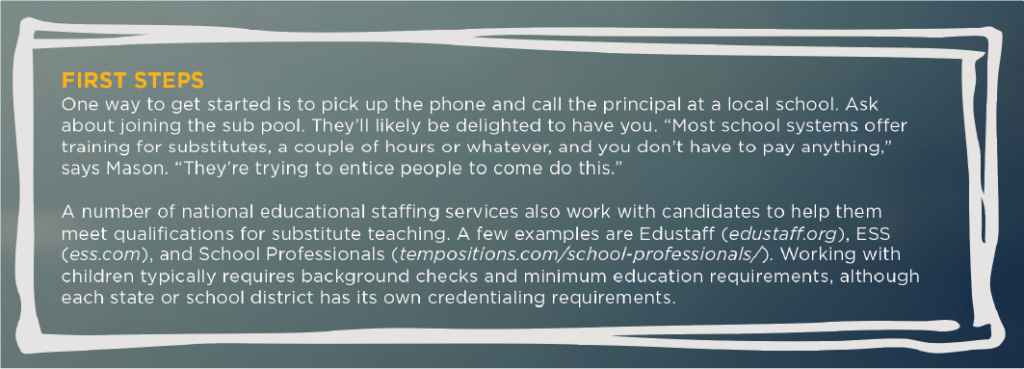
To make up for the shortfalls, school districts have tried raising pay, providing free training, and relaxing the requirements for joining the substitute pool. Most school districts have pathways for nonteachers to become substitutes, though the specifics vary.
Many former teachers, like Ford and Thesus, return to the classroom as substitutes after retirement, because they understand the dire need—and because it’s a pretty good gig. Trained, experienced educators are ideal substitutes, but anyone can be great at the job.
But I’ve Never Taught Before
If you’re an older adult or retiree from a nonteaching background, you can step up to help fill the gap. It doesn’t matter whether you’re familiar with the material. You can give a lot to students simply by drawing on your life experiences as a parent, coach, or professional.
“That’s what we need: more people who will take a day of leave from their job and sub once every month or two,” says James Monroe. “Then the school system could have a bigger bank of substitute teachers.” Monroe retired from a 15-year Air Force career before he moved into education. He worked as a substitute teacher in the 1990s before becoming a full-time high school teacher.
“You’ve got a wealth of knowledge you might not even realize,” he says. “You’d be surprised at the number of kids you might influence. Students really like having new people in their classrooms.” Male substitute teachers are especially needed, as kids tend to see fewer men working in schools.
Sometimes, the most valuable thing is a listening ear. If a student is struggling with an assignment, offer to help them read the directions. Ask them what they think they should do next. “A lot of kids don’t get that kind of attention from adults,” says Monroe.
Students benefit from exposure to diverse role models and hearing about different kinds of jobs. “If you’re subbing in high school, you can share how you got into your field,” says Ford. “You can help students fill out applications or make resumes.”
Grandparent Mentality
Thesus says being a substitute is easier and more fun than being a teacher, much like the trope that being a grandparent is better than being a parent. After retirement, she changed her attitude from “I’m their teacher” to “I’m their sub.”
“I get to enjoy all the positive things about teaching without the headaches,” she says. “I don’t have to deal with parents, discipline, grading, paperwork, lesson planning, or meetings. At 3:30, I’m going to leave this class behind.”
This mentality makes her more relaxed about things like how students act in the classroom. While she doesn’t allow fighting or extreme unruliness, “if they’re talking quietly in class, I don’t care,” says Thesus. “Behavior you can’t get away with at home, grandma doesn’t care!”
Working in a room full of kids from Gen Z or Generation Alpha can be an opportunity for older adults to keep current. People who haven’t spent much time around youth culture may find it invigorating, because many students today have a unique vibe. “A lot of kids today are treated almost like their parents are their friends,” says Monroe. “There are pluses and minuses to that, but they are then more comfortable and more open to speaking to adults, which is a good thing.”
Thesus has encouraged retired friends who have time on their hands to investigate substitute teaching. She touts the extremely flexible schedule, lack of late hours, and, in most cases, summers off. “You can choose when you want to work or not to work,” she says.
Becoming a substitute teacher can be a truly adventurous—but also simple—way to give back. Substitutes make a positive impact on the students in their classes, the schools where they work, and the broader community. After all, you never know whether something you bring to the classroom might become an important memory for one of the world’s future leaders.
By Jeanne Lee
Jeanne Lee is a freelance writer living in a lovely college town in Ohio. She has written about consumer and business topics for 20 years, including stints at Fortune and Money. her works has appeared in publications like USA TODAY, Fortune Small Business, and Health. She loves thinking about ways for people to hack their finances, and she daydreams about paying off her mortgage before she has to pay for college for her two boys.
Kirkland was skeptical and pressed him on his role, but Davis responded credibly and knew a lot about her relationship with the bank. He told her the fastest way to stop the unauthorized transaction was to give him access to her computer, which she reluctantly allowed.
Davis then wired $15,000 from Kirkland’s bank account to an individual in the United Arab Emirates via a wire transfer set up in her name. By the time Kirkland’s nagging doubts got the better of her, it was too late. The money was gone.
Fraud on the Rise
Cybercrime is how most money is stolen these days. “It’s a $10.5 trillion global industry that’s larger than the sale of all illegal drugs worldwide, combined,” says Mark Hurley, founder and chief executive officer of Digital Privacy and Protection (DPP). “It’s far easier to steal money with a computer than with a gun, and it’s far harder to catch the bad guys.”
Hurley, a serial entrepreneur in the financial services industry, saw a business opportunity in helping the clients of wealth managers guard their assets. He founded DPP in 2020.
According to a 2023 Gallup poll, 15 percent of U.S. adults said at least one member of their household had been the victim of a scam in the last year.
Karen Denise, head of wealth client service at CAPTRUST, says the Gallup data matches what she sees among clients. “Unfortunately, we’re hearing from more and more people that they have responded to a fraudster who appeared to be contacting them from a legitimate financial institution,” she says. “We work with them to try to recover their funds, but that can take time, and it’s very stressful.”
These sophisticated cybercriminals constantly innovate new tactics, making it difficult to stay ahead of them. To make matters worse, many such criminals work from outside the U.S., often placing them out of the reach of law enforcement. In the event they’re identified, they’re rarely prosecuted.
You’ve Been Hacked
According to Hurley, one of the most common tricks in recent months has been the “your account has been hacked” call.
Cybercriminals have become much more aggressive lately. In the past, they relied on text messages or emails to bait victims. Increasingly, they pose as company representatives and cold call their potential victims, ostensibly to help them address a hacked account.
“They’ll tell victims that their account has been breached and that they need to take certain steps to protect themselves,” says Hurley. “Typically, they’ll ask for specific personal information and direct the victim to open one of their apps and insert a code.”
Once the code is entered, the criminals can access the victim’s device and online accounts. They can move money or send a wire to themselves, as in Kirkland’s case. In one variation on this scam, the criminal convinces the victim to move the money themselves to protect the funds.
Losing money is bad, but that’s not always the extent of the issue. “When an investment or retirement account is involved, the damage can be compounded with taxes and tax penalties,” says Denise.
Someone’s Been Kidnapped
Another common fraud is the fake kidnapping scam, which seems even more frightening.
Criminals download videos from unprotected social media accounts and use artificial intelligence software to clone voices and images of people. They then call a victim and say they’ve kidnapped their loved one—often a child or grandchild—threatening to hurt them unless money is immediately sent to them either via wire transfer or cryptocurrency.
In the background, the relative will be screaming for help, and the call will appear to be from that person’s phone. To avoid detection, criminals may intercept the person’s calls. “As farfetched as this might sound, these criminals are very convincing and have a high success rate,” says Hurley.
These are only two of today’s dozens of scams. Enterprising cybercriminals are busy evolving their strategies and inventing new forms of stealing.
Danger Ahead
It’s important to be on alert for potential frauds. “Successful ones tend to include two common aspects,” says Hurley. “They’re trying to get you to act urgently, and the parties involved will sound genuine, maybe even like authority figures.”
These scams work because the criminals do their homework by collecting unprotected personal information on the internet. They know a lot about each victim before contacting them, so they sound especially convincing.
“A surprising amount of personal data is available online via public records and social media,” says Denise. This can include a person’s address, property value, phone number, email address, voter registration information, employer, job title, age, gender, race, and more.
Even worse, the information in unprotected social media accounts is effectively in the public domain, and anyone who wants to can access it.
Cybercriminals also regularly hack into people’s personal email accounts, so they know what’s going on in a potential victim’s life. “For all these reasons, the criminals will sound like they’re the real thing and can be very persuasive, even to sophisticated individuals,” says Hurley.
Small But Important
“While scammers today can be very sophisticated and convincing, there are some simple things you can do to protect yourself from them,” says Denise.
Here are a few tips you can start using immediately.
- Don’t talk to strangers. Don’t answer calls from people who aren’t on your contacts list. A legitimate person will leave a voicemail and callback number.
- Approach with caution. Most successful scams attempt to get you to act quickly and will sound like an authority figure. Be skeptical, and don’t get swept up in their urgency.
- Assume the worst. Neither your bank nor government agencies like the Internal Revenue Service (IRS) will call you about a problem. The bank will freeze your account; the IRS will send you a letter.
- Don’t share PII. Do not provide personally identifiable information (PII)—like passwords, and account, credit card, or Social Security numbers—to anyone who calls you on the phone. Legitimate service providers don’t typically ask for this kind of information over the phone.
- Call back. If you suspect you’re getting lured into a scam, hang up and call your bank, broker, or other service provider at a verified number.
- Protect your social media accounts. Criminals can use photos, videos, and check-ins shared on social media to target you unless you engage privacy settings on these accounts.
Key Defenses
There are a few important defensive actions that can also help immunize you against would-be scammers.
Privacy Settings
Managing the privacy settings in the apps, search engines, and browsers you use is critical. “Otherwise, you’re making it very easy for very bad guys to find you and steal your passwords and personal information,” says Hurley.
Each application has its own security settings, so you’ll need to dig in. Facebook, for example, has 80+ specific security and privacy settings to control who can see your profile, friends, posts, comments, and shares, and which apps and websites have access to your Facebook data. Beneath these categories lie many subcategories—and this is only one application.
Doing this yourself requires research and takes time, but it’s OK to lean on trusted experts. “For most people, it would take about 100 hours of work to figure out the settings and engage them,” says Hurley. “And companies regularly change them, so it’s not a one-time process.”
“We track privacy settings on the most popular applications and can implement
the right settings and set up password managers for our clients in a single three-hour appointment,” says Hurley.
Password Hygiene
Another key practice: Use long and complicated passwords. “AI systems can now correctly guess any eight-digit alphanumeric password in less than a second,” says Hurley.
To make your passwords effective and secure, use a minimum of 20 randomly generated characters—including uppercase and lowercase letters, numbers, and symbols.
Don’t use names, birthdays, or pet names, and never use the same password for more than one account.
Yes, this means you will have to juggle dozens of impossible-to-remember passwords. Thankfully, using a password manager, like LastPass, Keeper, or NordPass, can help you create, save, and manage passwords for your online accounts.
Device Security
The default settings on your personal computers and smartphones automatically record the passwords for every account that you access with them. That means if you haven’t turned on the appropriate security settings on your devices and a cybercriminal breaches your device, they’ll be able to access every one of your accounts.
It’s no more difficult than a thief looking over your shoulder as you enter your smartphone passcode at a restaurant and then stealing your device.
To help reduce this risk, use a complex passcode, a fingerprint, or facial recognition to unlock your device; set your phone to automatically lock itself after a short period of inactivity; and enable functionality to erase all information on your phone if it’s lost or stolen. Also, use multi-factor authentication (MFA) when it’s available.
MFA is a security process that requires you to provide two or more verification factors to access a resource. This is what is happening when your online account wants to send a text to your phone, then asks you to enter a code from that text before letting you log in.
Yes, MFA can be frustrating and slow you down when you’re trying to log into your accounts, but it is one of the very best defenses against scams and cyber threats.

“If you’ve been scammed, the quicker you take action, the less damage will occur,” says Hurley. “Once cybercriminals breach you, they quickly use the information they get to target every financial and social media account you have. This is how a single breach often leads to losing millions of dollars.”
After You’ve Been Scammed
What to do depends on how and what was breached. The first step is to figure out what happened and why and then take steps to minimize the damage.
This could be as simple as changing a password or as complicated as freezing your bank, custodial, and credit accounts, and making filings with the Federal Trade Commission, Federal Bureau of Investigation, and local law enforcement.
“Assume that, if you have been breached, the bad guys will soon return,” says Hurley. “Just as sharks regularly return to where they’ve been able to find animals to devour, cybercriminals return to target clients they’ve breached before.”
The Emotional Toll
Falling victim to a cybercriminal isn’t just a financial issue. Being scammed can erode the victims’ trust in others, and they may feel ashamed or embarrassed, especially if they lost a significant amount of money.
Also, scams can lead to feelings of anxiety and fear, as victims may worry about their financial security and the potential consequences of the scam.
These feelings can cause a victim to stay quiet or delay alerting the authorities about their situation. But it’s important to remember that acting quickly is the key to recovering lost funds and protecting oneself from future scams.
“Financial scams targeting older people can have a severe and long-lasting emotional impact,” says Denise. “It’s important to us to do everything we can to protect our clients and help them when they need us.”
By John Curry
CAPTRUST’s former Chief Marketing Officer, John Curry is now constructing his own second act and adjusting to unretirement in Spain. In the finance industry since 1986, Curry was instrumental in the launch of VESTED magazine, serving as its original editor in chief.
Though balance generally declines with age, many people don’t realize it’s happening until they take a tumble, says Debra Rose, professor and chair emerita of the Department of Kinesiology at California State University, Fullerton.
That’s what happened to Shana O’Brien, 58, the owner of a real estate brokerage in Vancouver, Washington, and Portland, Oregon. She was dancing with her husband in their home when one of her dogs ran between her legs, catching her off balance, and she fell. O’Brien says she landed on her bottom and one hand, crushing her wrist. To fix it, she needed surgery to implant a permanent titanium plate.
“It made me feel like a really old lady,” she says, but it was also a wake-up call. She had to do something to improve her balance.
For O’Brien, that something has been yoga. But experts say there are many activities—including other balance-focused workouts and tweaks to existing workouts and routines—that can help us stay firmly on our feet as we age.
The Facts About Falling
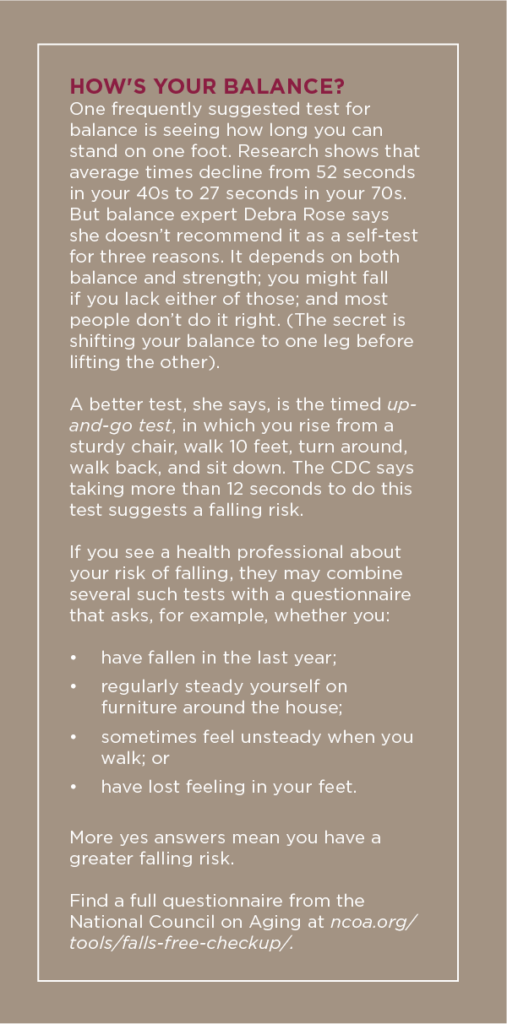
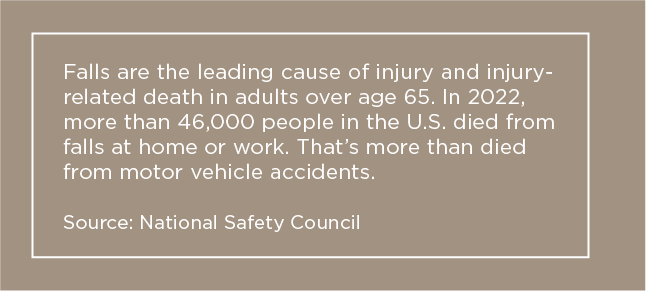
Falls are the leading cause of injury in adults over age 65, happening to one in four people every year, according to the Centers for Disease Control and Prevention. One large study found that, in women, injuries from falls start arising even earlier, between ages 45 and 55. Bad balance isn’t the only reason people fall. Everything from loose rugs to poor lighting to the wrong footwear can contribute, says Rose.
But the loss of balance that comes along with age is a bigger problem than many people realize. It not only increases the risk of falling but can also threaten your independence and keep you from doing things you love. “People stop going places and doing things because they don’t feel quite balanced enough,” she says.
Rose says this happens for several reasons, including age-related changes in proprioception: your body’s ability to sense its own position and movements. Proprioception relies not only on your brain but also on receptors in your skin, muscles, and joints, and on structures in your inner ear. Changes in vision, including poor depth perception, play a role, as do chronic medical conditions and medications.
As your balance declines, you might not immediatly notice as you walk more slowly, grab more handrails, and show other signs of unsteadiness. But you’ll be at risk every time you walk on an uneven sidewalk, encounter a wet floor, or reach down to pull a weed from your garden.
You might think it’s safest to just sit all day, but inactivity only makes things worse, says Carol Clements, a New York City dance therapist and personal trainer who is the author of Better Balance for Life. “Balance is a skill,” says Clements. “It gets better with practice and deteriorates without it.”
As people get wobblier, fear of falling can set in, leading to even more inactivity and worse balance, she says. “So, if you want to feel confident and be agile and not fall, balance training is important.”
What Counts as Balance Training?
If you like the idea of a class, you have choices. Many senior living communities, gyms, and fitness centers offer balance and fall-prevention classes. Rose developed a program, outlined in her book, Fallproof, that is taught at many places around the country. Other options include disciplines such as yoga, tai chi, and mat Pilates.
If you’ve been injured in a fall or are frail, your doctor should refer you to a physical therapist to decide the best balance-training program for you, Rose says. However, if you’re in reasonable health, there are lots of balance-boosting activities you can safely try as part of your regular workouts or daily routine. For example, you might consider the following.
- Lift free weights from a standing position instead of using a weight machine or bench. This combines balance and strength training.
- Do front and side-to-side lunges. These strengthen your legs, which is important for preventing falls, and might help you stay on your feet when you lunge in your next pickleball or tennis match.
- Work out on an unstable surface like a Bosu ball or a foam pad.
- Walk on uneven trails.
- Practice walking backward and shuffling side to side.
- Practice doing some activities with your eyes closed, after making sure you’re in a safe spot.
Clements suggests adding balance challenges to everyday activities. Here are a few ideas to try:
- Train yourself to brush your teeth while standing on one leg, starting with a finger on the bathroom counter and your toe just above the floor.
- Squat upward, and then down, from a sturdy chair using your buttocks, not your back muscles.
- Do heel lifts while working at the kitchen sink.
- Walk an imaginary tightrope while you talk on the phone.
Beverly Connell, 56, a legal assistant in Atlanta, Georgia, has come up with her own methods to overcome a fear of falling that started in her 40s, after three bad stair falls. For years, she says, she avoided stairs entirely. But the former gymnast recently decided she needed to regain her courage and her balance. She started climbing stairs again and got herself a rebounder, a mini trampoline that comes with a safety bar.
The first time she used it, says Connell, “I literally almost fell off.” These days, she says, she’s jumping without “hanging on for dear life” and taking the stairs at the train station without gripping a rail.
As for O’Brien, she’s studying to be a yoga instructor. She no longer feels like an old lady, she says, and thanks to her renewed balance and strength, “I don’t need to be afraid of falling every minute.”

By Kim Painter
Kim Painter is a freelance writer specializing in health, wellness, and retirement. She was a USA TODAY staffer and contributor for many years and now writers for AARP and other outlets. She lives in McLean, Virginia, where she practices what she preaches: wearing sunscreen, eating kale, and getting at least 10,000 steps a day.
Kids have dreaded and enjoyed the playground spinner in equal parts since the early 1900s. These brightly colored, circular contraptions, usually six to nine feet in diameter with metal bars for handholds, use angular momentum to turn, picking up speed to a sometimes-terrifying pace. If you were born between 1920 and 1990, you’ve probably ridden on one, or run around one, spinning your friends into a playground frenzy.
In recent years, the spinner has become a subject of debate, no doubt because it is connected with countless physical injuries, episodes of dizziness, and well-intentioned psychological trauma. Nonetheless, some experts contend that the spinner’s movements can be therapeutic to growing children, helping them develop strength, coordination, and balance. It also provides a helpful metaphor for work and retirement.
If you’ve ever ridden a playground spinner, you know it is always a struggle to stay on board, and sometimes, you can spend more than half of the ride trying to decide if you should just let go and jump off. Trying to find the right time to stop working is similar.
Finding the Right Time
High achievers tend to have a hard time making the jump to retirement. This may be true for a number of reasons. Some identify strongly with their work and feel concerned about their ability to move on. Societal messages that reinforce the value of work, stigmatize early retirement, or create fears of falling behind may create additional pressure.
“Others simply like what they’re doing and feel like they have more to contribute to the organization,” says Michelle Scarver, a CAPTRUST financial advisor in San Antonio, Texas. “Or, frankly, they may just be having fun.”
Others may have golden handcuffs—unvested benefits of some kind—that create uncertainty about timing or even financial disincentives to retire.
Golden handcuffs can come in the form of a compensation package, stock incentive plan, deferred compensation, bonuses, or other perks. “Golden handcuffs tend to amplify the decision about when to retire, and they can complicate the analysis of a retirement plan,” says Nick DeCenso, head of wealth management solutions at CAPTRUST’s headquarters in Raleigh, North Carolina.
For others, money is a scorecard, and they fear losing relevance or social standing.
“Moving into retirement is a big decision, both financially and emotionally,” says Scarver. “As financial advisors, we can help address the financial side with a thorough plan so people can give themselves permission to retire, but 90 percent of the decision is emotional.”.
How Brains Resist Retirement
There are several cognitive biases at work here. The sunk cost fallacy may make it difficult for high earners to walk away from the investments they’ve made in their own knowledge and experience. And loss aversion—the tendency to weigh potential losses more heavily than potential gains—may cause them to focus on what they think they might lose (e.g., status, income, and purpose), rather than what they stand to gain (e.g., more free time, deeper relationships, and experiences).
These high earners could also be in their peak earning years, so fear of missing out (FOMO) may make them think the best is yet to come financially. This manifests in thoughts and comments like “Next year is going to be big, so I don’t want to lose out,” or “If I can just do this for another year or two, we won’t have to worry about money.”
One important question that also arises when considering the right time to retire: How long can I expect to be healthy?
“Financial planning plays a big role in confirming to people that they will be OK, even despite the rising cost of health care, but health is always a concern,” says Scarver. “Clients tell me all the time that they don’t want to miss out on good years of retirement due to failing health, and they want to be able to enjoy the retirement they saved and planned for.”
Flipping FOMO on its head is one strategy that may help create clarity around this key decision.
Talking to family and friends about—and, ideally, even documenting—the interesting and exciting things you plan to do after you stop working may help tip the scales in favor of retirement over more work and more money. Tangible plans can trump vague fears.
Put another way: It’s important to name the risks of staying on the spinner and the rewards of stepping off.
Three Transition Tactics
Here are a few other tips that may help you feel more comfortable with the transition from work to retirement:
Investigate your handcuffs. If you have unvested benefits with your employer, you may find that you’ll lose less than you fear. For example, tiered vesting on retirement plans, stock programs, and deferred compensation plans could mean that you keep the lion’s share of those benefits when you retire. “The best way to gain confidence in your decision is to have a well-developed retirement plan—one that factors in the golden-handcuffs dynamic and focuses on meeting your personal goals in retirement,” says DeCenso.
Determine how much is enough. “One common transition hurdle is that it’s hard to get comfortable with not having a paycheck,” says Scarver. “For a while at least, it can make people feel uneasy to start drawing money from their savings to pay for everyday living expenses.” After watching your savings account balance grow for so long, it can feel stressful to watch that money slowly decrease, even if you know this is what you saved it for.
One way to manage these feelings? Rather than focusing on the total value of your accumulated retirement savings, visualize this money as regular income using the four percent rule. Multiply the value of your portfolio by 0.04. The resulting number is the level of cash flow your portfolio should be able to support. You may find you already have more than enough to breathe easy.
Practice mindfulness. Biases are sneaky because they operate outside of our conscious minds. Managing them means staying alert to the moments when you feel you may be falling prey. Then, you can interrupt your brain’s natural tendency to be more thoughtful and intentional instead.
Did you just feel a pang of FOMO looking at the calendar for the upcoming work year—or wonder what you’d do this year without work? Once you realize what you’re feeling, you can contemplate that feeling more logically and rationally so you aren’t just reacting to passing emotions. The more you practice, the better you’ll get at it.
Once you have tried these tactics, it might also be a good idea to identify your personal goal line. And, of course, you’ll want to validate your assumptions.
Working with your financial advisor to document this plan and check your progress along the way will help make sure those couple more years don’t keep slipping into the future. It’s easy to keep moving your own finish line.
“There will always be more work than can be finished, and there will always be money left on the table,” says Scarver. “But for most of us, work is not the point of living.”
By John Curry
CAPTRUST’s former Chief Marketing Officer, John Curry is now constructing his own second act and adjusting to unretirement in Spain. In the finance industry since 1986, Curry was instrumental in the launch of VESTED magazine, serving as its original editor in chief.
David Sedaris, who has authored more than a dozen books and hundreds of essays, has a generous following. According to his website, there are more than 10 million copies of his books in print, and they’ve been translated into 25 languages. He frequently fills large auditoriums across America with audiences eager to hear him read.
Yet Sedaris says he typically spends more time picking up trash than writing—nearly eight hours a day on average, often covering 20–25 miles on foot.
Over time, Sedaris has turned this hobby into a personal mission. In fact, he’s become so well known for his efforts that his local council named a garbage truck after him. It’s called Pig Pen Sedaris and has a cartoon pig painted on its side.
“I do it because I want to live in a nicer environment,” Sedaris told the West Sussex County Times. “I’m angry at the people who throw these things out their car windows, but I’m just as angry at the people who walk by it every day. I say pick it up yourself. Do it enough and you might one day get a garbage truck named after you. It’s an amazing feeling.”
Sedaris’s obsession with garbage might seem bizarre to some, but his commitment to cleaning up his community also demonstrates how seemingly insignificant actions can become a legacy.
The Litter Problem
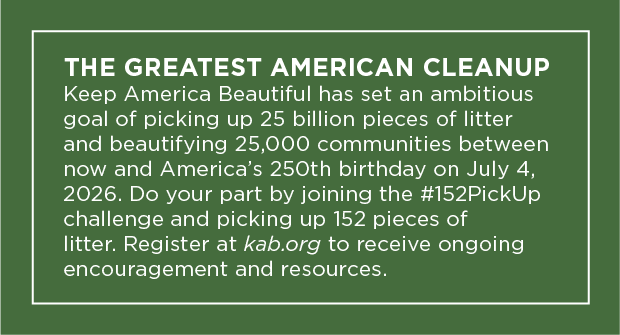
Littering is a global issue, with millions of tons of trash accumulating in urban, suburban, and natural areas every year. According to the nonprofit Keep America Beautiful, the U.S. alone spends almost $11.5 billion annually on litter cleanup, and there are currently more than 50 billion pieces of litter on the ground. That’s 152 pieces for every American.
Cigarette butts, bottles, food wrappers, and other debris harm wildlife, pollute waterways, and reduce the aesthetic appeal of communities. Plastic waste, in particular, breaks down into microplastics, which can find their way into the food chain, posing health risks to plants, animals, and humans.
However, studies show that individual actions, like Sedaris’s, can have a compounding effect. For example, the presence of litter in an area can encourage further littering, a phenomenon known as the broken windows theory. Conversely, a clean, litter-free environment promotes a sense of communal pride and discourages further trash from accumulating. It’s proof that when even one person decides to act, they can inspire a ripple effect.
Tips for Picking Up Litter on Your Own
The benefits aren’t just communal; they’re personal, too. Many people find that picking up litter provides a simple form of exercise and a sense of accomplishment. There’s something deeply satisfying about seeing a messy area transformed through your efforts.
Moreover, taking action—no matter how small—can provide a mental health boost, giving you a sense of agency and control in the face of overwhelming environmental issues.
Picking up litter doesn’t require a lot of equipment or planning, but there are a few tips to make it easier, safer, and more enjoyable. Start by taking a small bag or bucket and gloves on your daily walk. You might also consider buying a litter grabber: a long, pole-shaped tool with a claw on the end that helps you reach things without bending over as often.
Remember, you don’t need to clear an entire beach or forest to make an impact. Simply cleaning up your street or a nearby park can be rewarding. If you make it a habit, you might find that you look forward to the process. As Sedaris says, “You do it because it needs doing, and you like the feeling of making a small difference.”
Finding Like-Minded People
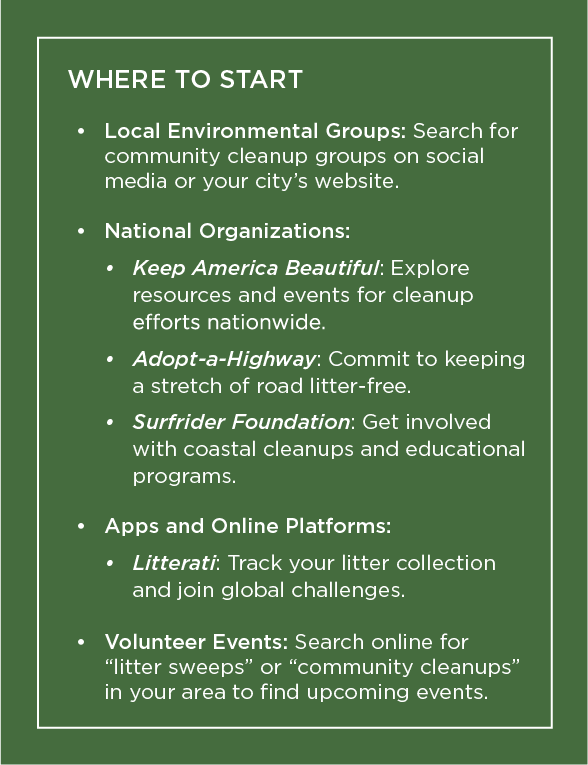
While picking up litter alone is impactful, joining a community effort can amplify the results. These not only cover more ground but also inspire others to participate. Group cleanups can also be a great way to meet people who share your commitment to keeping public spaces litter-free.
Nonprofit environmental organizations like Surfrider Foundation and Keep America Beautiful often host local events, which can range from beach sweeps to greenway cleanups. Many cities and states also organize community days, where residents gather to remove litter from streets, waterways, and public spaces. Adopt-a-Street and Adopt-a-Highway programs are another way to help and are available in most cities and suburbs.
Every Little Bit Counts
At a time when environmental challenges can feel daunting, picking up litter is a simple, tangible way to make a difference. Every piece of trash removed is one less item polluting the environment, harming wildlife, or degrading the beauty of natural spaces.
If you want to give it a try, start small. Collect litter on your daily walk or join a community event. “You don’t need to be a hero,” says Sedaris. “Just someone who wants to live in a better world.” By taking action, you’re not just picking up trash. You’re also inspiring others to do the same and proving that small efforts can indeed lead to big change.
By Roxanne Bellamy
Roxanne Bellamy is editor in chief of VESTED magazine. She has a Bachelor of Arts and Master of Philosophy in English and has written for many industries, including beer, textiles, and finance. Her work has appeared in Fast Company, Inc., Forbes, and more. Her retirement dream is to be a National Geographic Explorer.
Getting a new car is a big decision. Even accounting for inflation, cars today are significantly more expensive than they were 25 years ago. So before you start test-driving your dream ride, you have a choice to make—buy or lease? A handful of issues will drive the decision for you.
Leasing usually means a smaller down payment and smaller monthly payments. The downside: When the lease ends, you won’t own the car. If you purchase a car and use credit or financing, you’ll typically need a larger down payment, and your monthly payments will be higher. But once you’ve paid off the loan, the car is all yours—with no more payments. You can sell it later and recoup some of your outlay.
If you’ve got the cash, you can buy the car outright and drive it until the wheels fall off, with no monthly payments. You’ll forfeit the earnings power of that cash, but you’ll save by not financing either by loan or lease.
Now think about how much you drive. Are you constantly on the road, or is your car mainly for quick trips around town? If you’re a road warrior, buying might be a better idea. Leases come with mileage restrictions—usually between 10,000 and 15,000 miles per year. Drive more than the limit, and you could be looking at some hefty fees at the end of your lease term.
If you’re always itching to drive the latest models, leasing might be right for you. You can get a new car every few years when your lease ends. Plus, the car is usually under warranty for the entire lease period. But if you know you’re likely to get attached to the car and don’t mind driving the same vehicle for years, buying could be the way to go.
One more thing to consider: If you’re the type of person who likes to customize their vehicle, buying is probably your best option. When you own the car, you can modify it however you want. With a lease, you can’t make permanent changes. And leasing companies can be picky about wear and tear, which might mean extra fees when you turn it in.
So what’s the bottom line? If lower monthly costs and driving a new car every few years sound good to you, leasing might be right. But if you’re a high-mileage driver, want to customize your ride, or prefer to own an asset long term, buying could be better.
Remember, there’s no right or wrong answer. It all comes down to your personal situation. Think about your budget, your driving habits, and your plans. The best choice is the one that fits your lifestyle and budget.
There is an old proverb that says, “If everything is going well, you may not know everything that’s going on.”
Many life insurance policies are not funded with adequate premiums to keep coverage in force until death. In recent years, the risk of underperformance for many policies has been shifted from the life-insurance carrier to the policy owner and the trustee as a fiduciary.
Investment returns and non-guaranteed expenses are typically explained by insurance carriers on annual policy statements, but they can be hard to find and even harder to decipher. This is particularly a problem for trust-owned life insurance where the trustee is under a fiduciary duty to manage risks and monitor the performance of the trust policies.
Trustees of trust-owned life insurance policies are guided by the Prudent Investor Act. This act requires anyone with control over another person’s assets to acquire investments or manage existing funds in such a way that the holdings will be exposed only to risks that a reasonably intelligent and cautious person would consider worthwhile. In other words, their actions must have a low probability of permanent or long-term losses.
A fiduciary who breaches the Prudent Investor Act can be held responsible for damages. They are also often responsible for the recovery of losses incurred by inadequate life insurance acquisition processes, ineffective ongoing management, or inappropriate investment strategies. Additionally, if a policy lapses before the insured person’s death, the trustee may be held responsible for not properly reviewing and managing the policies.
For trusts that own policies, annual life insurance reviews are essential. These should include in-force illustrations and appropriate benchmarking. The trustee should follow appropriate guidelines and procedures for managing the policies, including keeping detailed records, illustrations, notes, and summaries of actions taken at review meetings.
Financial advisors who have expertise in managing life insurance can assist with providing a comprehensive review. Insurance carriers do not provide comprehensive reviews or advice.
Without professional management, the policy owner may be required to pay substantially higher future premiums. They may also be at increased risk of the policy lapsing before the insured person’s death. A life insurance portfolio review can identify policies that are underperforming and that may lapse or require dramatically higher premiums in the future.
In many cases, existing policies can be edited and improved. Alternatively, improvements can be achieved by comparing existing coverage to policies offered by other insurance carriers. Comparison shopping can result in lower premiums for the same amount of coverage, more coverage for the same premiums, or more predictable premiums with less risk.
American Airlines Breached Duty of Loyalty, But Not Prudence, in ESG Case—On Unique Facts
As previously reported, American Airlines and its 401(k) plan fiduciaries were sued for inappropriately including investments with environmental, social, and governance (ESG) considerations in their plans. The plans offered BlackRock Index funds, which made up approximately $11 billion of the plans’ $26 billion in assets in 2022. As the judge observed, BlackRock actively supported ESG efforts and social change by making investment decisions and voting proxies on this basis. American Airlines had also publicly endorsed ESG efforts as an important part of its long-term success. Additionally, BlackRock was a significant investor in American Airlines, holding more than 5 percent of American Airlines’ stock and approximately $400 million of its corporate debt. As detailed below, the judge found that American Airlines “incestuous relationship with BlackRock and its own corporate goals disloyally influenced administration of the plans.” Spence v. American Airlines, Inc. (N.D. Tex.).
The lawsuit alleged that American Airlines and its plan fiduciaries had violated ERISA’s prudence and loyalty rules. After reviewing the plan fiduciaries’ processes, the judge decided there was no breach of fiduciary prudence. The plan fiduciaries had a robust process, which included an independent outside investment consultant, regular quarterly investment reviews, and quarterly meetings. The judge concluded that American Airlines’ fiduciary process was in line with the industry norm. However, meeting industry norms, which, according to the judge, are effectively set by a few large players, does not safeguard against breaches of loyalty.
With respect to loyalty, the judge observed that ERISA “requires a fiduciary to always act solely for the plan and in the plan’s best financial interests—not just some of the time.” Plan fiduciaries must follow an “analytically rigorous standard when it comes to a fiduciary exclusively pursuing the best financial interests of the plan.”
Loyalty considers the reasons why a fiduciary acted, not the process of acting. ESG investing, by definition, pursues a non-pecuniary interest as an end itself rather than as a means to achieve financial results. If there is a solid premise that ESG factors will advance a company’s financial performance and could reasonably lead to positive financial outcomes for plan fiduciaries, the investment is considered pecuniary.
The BlackRock investments in the American Airlines plans were all indexed investments. In indexed investments, the composition of the holdings is dictated by the index that is being tracked (e.g., the S&P 500 Index) and not by the investment manager’s discretion (in this case, BlackRock). As a result, BlackRock had no discretion to pick and choose the companies whose stocks would be included. Noting its support for ESG, BlackRock’s CEO explained that, for index fund holdings, it would use its proxy votes to drive social change.
The judge took particular note of a lapse in regular quarterly reporting of proxy voting by BlackRock to the American Airlines plan fiduciaries. The judge also noted the plan fiduciaries’ failure to realize or call out the reporting failure. One individual at American Airlines was responsible for its corporate relationship with BlackRock and also had day-to-day oversight of the plans’ investment managers. This person’s failure to keep the roles separate and provide oversight of BlackRock’s proxy voting was seen as evidence of subordinating the interests of plan participants and sacrificing investment returns to promote goals unrelated to the interests of the participants. The judge observed that most 401(k) fiduciary committees do not receive regular reporting on proxy votes, so this lapse demonstrated the fiduciaries “turning a blind eye” to proxy voting, but not a prudence failure.
In reaching his decision, the judge gave considerable weight to the compound factors indicating that American Airlines and the plan fiduciaries were motivated by ESG considerations and BlackRock’s influence rather than being motivated to pursue the best financial results for plan participants. These factors included the similar corporate ESG positions of BlackRock and American Airlines, and the judge’s belief that BlackRock’s significant ongoing equity and fixed-income investment in American Airlines influenced American Airlines and its plan fiduciaries to support ESG-related priorities.
Key takeaways from this decision include:
- the critical importance of corporate executives being clear about their respective fiduciary and non-fiduciary roles—and keeping them separate;
- the complications and risks of having corporate service providers and investors who are also involved with retirement plans (there can be no corporate quid pro quo based on plan matters);
- the importance of plan fiduciaries understanding what their plan’s investment managers seek to accomplish and whether they are pursuing anything beyond participants’ best financial interests; and
- the importance of plan fiduciaries’ understanding how proxies are handled for the assets in their plans.
This decision is likely to be appealed, and, following the Supreme Court’s elimination of Chevron deference, the Department of Labor will not be able to control courts’ interpretations of ERISA. Therefore, varying district and appellate court opinions are likely. The legal environment for ESG investing in retirement plans will continue to be uncertain and remain a likely target of legal challenges.
Note on Proxies: We can expect an increased focus on how plan fiduciaries handle proxies. Here is a quick refresher.
- Proxies issued on holdings in separate accounts and collective investment trusts must be voted in the best financial interests of plan participants. This voting is frequently delegated to the investment manager. If so, plan fiduciaries must monitor how proxies are voted. (This was the issue in the American Airlines case.)
- Proxies issued by holdings in mutual funds will be voted by the investment managers. Fiduciaries should understand the mutual fund’s investment philosophy and whether non-financial interests are a goal.
- Proxies issued by mutual funds must be voted in the best financial interests of plan participants. These will include issues like the election of the mutual fund board and changes in the mutual fund investment policy.
UnitedHealth Group Settles Target-Date-Fund Challenge for $69 Million Settlement Amid Conflict-of-Interest Allegations
As previously reported, fiduciaries of the UnitedHealth Group 401(k) plan were sued challenging their retention of underperforming target-date funds. The complaint alleges that the company’s retirement plan continued to offer Wells Fargo target-date funds from 2015 to 2021, even though these funds consistently and significantly underperformed. Snyder v. UnitedHealth Group (D. Minn., filed 2021).
Through the litigation discovery process, the plaintiffs claim to have found evidence that, even though the UnitedHealth fiduciary committee had decided to remove the Wells Fargo target-date funds, UnitedHealth’s chief financial officer (CFO) interceded to keep the funds in place. After discovering the CFO’s intervention, the participants’ claims were expanded to add the CFO as an individually named defendant.
The amended complaint alleges that the CFO directed an evaluation of UnitedHealth’s business relationships with Wells Fargo and the other firms whose funds were candidates to replace the Wells Fargo target-date funds. Upon determining that Wells Fargo was a significant business partner, the decision to replace the Wells Fargo funds was reversed. Soon after, the plan’s fiduciary committee was restructured to include the CFO, who had not previously been a member. The complaint contends that UnitedHealth’s plan fiduciaries put the plan sponsor’s business interests and profits ahead of plan participants’ interests, thereby violating ERISA’s exclusive benefit rule and causing losses for plan participants.
Against this backdrop of alleged conflicts of interest, the case has reportedly been settled for $69 million, which appears to be a record amount in a suit alleging the improper retention of underperforming investments.
Like the American Airlines case, this one is a reminder that, under ERISA, plan fiduciaries and sponsors may not make plan-related decisions that benefit corporate interest and compromise plan participants’ interests, and that even perceived conflicts of interest should be avoided.
Pension Settlements: Legal Challenges Continue
In recent years, many pension plan sponsors have fully or partially closed out their obligations to plan participants by purchasing annuities to fund participants’ earned benefits. The applicable fiduciary rules do not permit plan fiduciaries to seek the least expensive annuities. Rather, they must select the “safest available” annuity provider, and there can be more than one “safest” provider at any given time.
We have recently reported on several lawsuits challenging the selection of Athene as an annuity provider, most of which allege that it did not meet the safest-available-provider requirement. In those cases, Athene has been characterized by the plaintiffs as a “highly risky private-equity-controlled insurance company with a complex and opaque structure.”
In a recent suit, Verizon and its independent fiduciary, State Street Global Advisors, were challenged for entering a pension settlement of $5.7 billion and covering 56,000 pension plan participants. Prudential and RGA Reinsurance took on the pension liabilities. Prudential is a frequent party in these transactions.
The suit alleges that Prudential and RGA were not the safest available providers. Importantly, the case goes on to claim that State Street was motivated in its selection of Prudential and RGA by its own self-interest, due to its investments in Prudential, RGA, and Verizon. Dempsey v. Verizon Communications, Inc. (S.D. N.Y., filed 12.30.2024).
This case is in the early stages of litigation. Some commentators have expressed surprise at seeing a case like this involving Prudential, which is frequently selected as the “safest available” provider. One commentator observed that, if this case survives a motion to dismiss, the plaintiffs will have the leverage to force a settlement. And if that happens, similar cases are likely to follow.
Supreme Court Hears Case on What’s Needed in a Viable ERISA Complaint, Oral Argument Did Not Suggest an Outcome
Due to conflicting decisions in U.S. courts of appeal, the Supreme Court accepted a case to decide what must be included in a lawsuit alleging an ERISA-prohibited transaction violation. The law in this area is not clear. Some federal appellate courts consider many common day-to-day relationships to be prohibited transactions. In this situation, a suit can be brought forward with minimal facts, then the plan fiduciaries must prove there was no loss to plan participants. Other federal appellate courts require an allegation that fiduciaries overpaid for a service or purchased an unnecessary service. In this situation, the plan participants who are suing must prove there was a loss.
Frequently, comments and questions from Supreme Court justices during oral argument offer an indication of how a case will be decided. Not so in this case. Justice Barrett asked, “Why on earth” did Congress structure this part of ERISA the way it did? And Justice Sotomayor said, “This isn’t that easy a case in my mind.” Cunningham v. Cornell University (S. Ct., argued January 2025).
If the Supreme Court decides that plaintiffs who bring suit are not required to allege and show damages, the volume of plan-related lawsuits based on ERISA-prohibited transactions can be expected to grow significantly. A decision is expected by the middle of the year.
Vanguard Settles Target-Date-Fund Claim for $40 Million—Along with a $106 Million Penalty
In 2021, Vanguard lowered the minimum investment required to use the institutional share class of its target-date funds from $100 million to $5 million. This offered investors a significant fee reduction. As a result, a large amount of money left the retail share class to move into the less expensive institutional share class, which is a separate fund structure. To accommodate the movement of these assets, the retail share class investment managers sold significant amounts of holdings. For retail investors in taxable accounts, this triggered capital gains taxes. Tax-exempt accounts, like 401(k) plans, did not have this issue.
Retail investors in taxable accounts sued Vanguard for repayment of the capital gains taxes incurred because of the retail share class sell-off. In re: Vanguard Chester Funds Litigation (E.D. Penn. 2024).
Settlement of this case for $40 million was recently reported. In addition, the Securities and Exchange Commission has assessed a $106 million penalty for misleading statements related to capital gains and tax consequences of the sell-off.
A fresh, new year is a catalyst that drives nearly everyone in the money management industry to unpack their fortune-telling tools and make predictions. These forecasts are designed to impress the public with concise narratives that sound reasonable and wise, but they often add more confidence than value in the decision-making process.
At CAPTRUST, one of our fundamental portfolio management principles is that we do not predict; we prepare. To help us understand the range of possible futures we need to prepare for, we use four levels of analysis: the range of possibilities, probabilities, market expectations, and sources of uncertainty, in that order. Each level requires a different set of subjective decisions.
We consider this preparation and prediction process to be an ongoing thought experiment, not just in January but throughout the year, and we adapt as new information becomes available. We approach this exercise, beginning to end, with a healthy dose of caution and humility.
Here are the four primary levels of analysis we conduct when evaluating the macroeconomic landscape.
Level One: The Range of Possibilities
Legendary investor Howard Marks once said, “The future does not exist. It is only a range of possibilities.” In part one of our analysis, we attempt to define the range of near-term possibilities. We ask ourselves: what could the headlines say 12 months from now?
While this initial level of analysis only scratches the surface, it also provides a foundation for the other levels. In this level, the goal is not to make a prediction. It’s to determine whether the full range of potential economic scenarios has a mostly negative or mostly positive bias. That is, are there more negative or positive scenarios that could unfold this year?
For 2025, we see three primary possibilities. From most negative to most positive, they are:
- Optimism fades. In this scenario, sticky inflation keeps interest rates high in the U.S. while global economic activity decelerates. The productivity value of artificial intelligence (AI) lags, and earnings expectations soften against a backdrop of elevated valuations.
- More of the same. Despite continued AI enthusiasm, inflation hovers near the Federal Reserve’s target range. As a result, the forward path of interest rates and market leadership remains highly sensitive to each new data release.
- An upside surprise. Inflation pressures continue to ease as productivity begins to accelerate, with AI efficiencies becoming more widespread. This strong economic tailwind, combined with falling interest rates, supports double-digit earnings growth across corporate America.
This level one analysis of all the things that could happen helps us understand the overall risk landscape. Then, in level two, we assign probabilities to each possibility to determine what actually might happen next.
Level Two: Probabilities
Humans have a difficult time interpreting probabilities. Early in life, most people are taught the mathematics of certainty instead, so we tend to believe there are only two probabilities: 0 percent and 100 percent. In reality, few variables across the investment landscape have such binary outcomes.
Investing requires making judgments about a future in which essentially anything is possible and nothing is certain. Understanding the probabilities of each possible scenario helps us prioritize what we need to prepare for.
Unsurprisingly, when we assign probabilities to the range of possibilities, our expected near-term future looks a lot like our recent past. This is because short-term market moves are primarily driven by momentum. Without a change in a critical market assumption, a comfortable default for most forecasters is to assume there will simply be more of the same. And indeed, more of the same is the most likely scenario for this year.
We believe each of the three possible scenarios has a percentage probability of coming true in 2025.
- Optimism fades: 10 percent
- More of the same: 50 percent
- Upside surprise: 15 percent
Based on these first two levels of analysis, you could reasonably (and accurately) deduce that CAPTRUST is predicting a generally favorable outlook for the economic landscape—not the doom-and-gloom recession you might be fearing. That doesn’t mean a recession isn’t possible. It just means a recession is not highly likely.
The economy is sound, inflation is trending favorably, the labor market is robust, and under the new administration, regulatory burdens are likely to ease.
Most investment outlooks stop here and are circulated with this degree of explanation, leaving individual investors feeling empowered to take additional risk within their portfolios.
However, it is important to remember that this two-level outlook is incomplete. To be fully prepared, investors must also consider the next two levels.
Level Three: Market Expectations
One of the most difficult concepts investors must learn is that markets do not trade on good or bad outcomes. They trade on better or worse outcomes—that is, better or worse than what was expected.
While the first two levels of analysis are critical to understanding the economic backdrop and likelihood of certain outcomes, for investment decision-making, they are mostly useful as context clues to help evaluate whether the expectations already embedded in market prices are reasonable or not.
At any given time, current market prices incorporate the consensus investor outlook. A forecast that aligns with the consensus view will not provide excess value. Only a view that is better or worse than the consensus has the potential to add or remove value. But remember, while the consensus may not be correct, it captures the wisdom of the crowd.
The challenge is that nobody truly knows what the consensus views are. So we must interpret multiple data points, such as investor sentiment, equity valuations, earnings, interest rate projections, and credit spreads, to build estimates of consensus opinions. These data points change daily.
At present, the U.S. landscape reflects high investor sentiment, higher equity valuations, optimistic earnings projections, and near-record-low credit spreads. In other words, the consensus view—like CAPTRUST’s—is a favorable outlook for economic activity.
The question is how do CAPTRUST’s expectations compare with what we believe the market is projecting?
A good economic outcome can still be disappointing if the market was expecting something great. That’s why, sometimes, the best investments are those for which people have the lowest expectations. But also, sometimes, low expectations come with higher risk, because the consensus view is almost always based on valid reasoning.
Level Four: Sources of Uncertainty
In his 1921 book Risk, Uncertainty, and Profit, Frank Knight formalized a distinction between risk and uncertainty. Risk, he argued, is an unknown outcome for which the distribution of potential outcomes is known. Uncertainty, on the other hand, is an unknown outcome for which the distribution of potential outcomes is also unknown.
Astute readers may have noticed that our level two probabilities for likely economic scenarios only add up to 75 percent. What became of the remaining 25 percent? It is captured in what we believe to be an environment of heightened uncertainty. In other words, there is a 25 percent chance that something entirely unpredictable could happen.
This uncertainty is driven by a few primary factors.
Policy Questions: As President Trump’s new leadership structure is finalized, we will gain clarity on his administration’s upcoming policy agenda. While many expect that his proposed deregulation policies will support economic growth, many of his other proposed policy measures could create economic pressures. It’s not possible to conduct mass deportations, place broad tariffs on imports, and cut $2 trillion from government spending without putting upward pressure on inflation and downward pressure on gross domestic product growth. The president and his leadership team will likely be discussing these and other economic consequences when deciding which policies to enact and their timing.
The Federal Reserve is also awaiting clarity. Fed Chairman Jerome Powell has said the Fed will remain data dependent and not consider potential policy shifts or hypotheticals in its decision-making process. This adds another element of uncertainty, potentially raising the odds of a monetary policy error.
The Domestic Fiscal Situation: The president and his team will also need to consider how proposed policies could impact the U.S. fiscal situation. Deficits, debt ceilings, and debates will likely continue to contribute to heightened unease and market volatility. However, the promise of improved productivity from AI advancements may offset anxiety.
AI Productivity Gains: It’s possible that just about any short-term economic outcome could be overwhelmed by AI productivity gains and hype. However, the timeline for gains remains unclear. The AI revolution could happen faster—or much slower—than expected. In the meantime, as long as investors remain confident in AI’s long-term potential, it may not matter whether near-term corporate earnings expectations are realized.
Forecasting 2025
At CAPTRUST, we work hard to stay aware of how much we don’t know. The future is unpredictable, yet we revel in predicting, because a thorough prediction means we can be prepared for a wide range of potential outcomes.
It would be easy to think there’s no value in predicting. But the value is in the process, not the predicted outcomes. By trying to forecast what will happen next, we are forced to define our expectations, interpret the market’s expectations, and identify sources of uncertainty.
This year’s expectation: We believe the economic foundation is strong, with falling inflation, a robust labor market, a financially sound consumer, and an easing regulatory environment. Right now, we’re seeing high stock valuations and minimal premiums demanded for taking credit risk. This means market participants may be even more optimistic than CAPTRUST is when interpreting the forward path of the economy and the markets.
Still, we’re seeing elevated uncertainty, driven by shifting political policies, an unsustainable fiscal position, and soaring excitement around AI. Any of these factors could cause this year’s outcomes to fall outside our expected range.
Against this backdrop, we are approaching 2025 with caution and optimism. There are many things to like about the current economic landscape. However, the combination of elevated investor optimism and heightened market uncertainty can sometimes create pitfalls. We’re keeping a close eye on many factors.
This year, like in many of the years before, the most important positioning characteristic will likely be the ability to change course if the outlook changes.
Key provisions of this guidance are as follows.
Roth Catch-Up Contributions
- Pretax catch-up contributions made by those earning more than $150,000 in the previous calendar year will be automatically designated as Roth contributions. No special election is required.
- When determining whether an employee qualifies for the Roth restriction on catch-up contributions, there will be no proration of wages for the prior year. Thus, new 2026 employees and those who worked for part of 2025 will only have their 2026 catch-up contributions designated as Roth if their Federal Insurance Contributions Act (FICA) wages for 2025 exceeded $150,000.
- Since qualification depends on FICA wages, individuals who do not have FICA wages from the plan sponsor will have no restrictions on their catch-up contributions, regardless of salary. This includes certain state and local government employees and partners in a partnership who have only self-employment income. Those with no FICA wages can choose to designate their catch-up contributions as pretax or Roth.
- Plans may not require that all catch-up contributions be Roth in order to circumvent these new rules.
- Roth contributions made before the participant has reached their general 402(g) elective deferral limit will satisfy the catch-up Roth requirement if the elective deferral limit is exceeded, even though these funds were contributed to the plan before the participant reached the elective deferral limit.
- Plans without a Roth feature will not be allowed to provide a catch-up option for those who earned more than $150,000 in FICA wages from the plan sponsor in the previous calendar year.
Auto-enrollment Requirement for Plans Created After the Passage of SECURE 2.0
- If a plan created before SECURE 2.0 joins a multiple employer plan (MEP) or pooled employer plan (PEP) that was also created after SECURE 2.0, the joining plan will not be required to have auto-enrollment.
- For plans that are subject to SECURE 2.0’s autoenrollment requirement, all new employees must be automatically enrolled. Existing employees who have never made a deferral election or an affirmative election to opt out of the plan must also be automatically enrolled.
- To determine the 10-employee threshold at which an employer’s plan would become subject to auto-enrollment requirements, the IRS will use existing Continuation of Health Coverage (COBRA) rules.
- For MEPs and PEPs, the IRS will determine the 10-employee and three-year thresholds using an employer-by-employer basis. These thresholds will not be based on the number of employees in the MEP or PEP, nor will they be based on the creation date of the MEP or PEP.
It’s important to note that these IRS regulations are not yet final. They include a 60-day comment period from their date of publication in the Federal Register. A public hearing is scheduled for April 8, 2025.
Close
Close
"*" indicates required fields
Close
"*" indicates required fields
Close