Second Act: Bill Kerig Won’t Stay Still
By Roxanne Bellamy
Wind whips through New York City as Bill Kerig opens the door to an overheated East Village thrift store.
It’s 1984, and 23-year-old Kerig needs cash to finance the first of many life-changing decisions. Despite his new finance degree, plus stints in insurance and currency trading, he knows a financial career is not for him.
He wants to go skiing to figure things out.
“People have been going to the mountains for centuries, looking for meaning,” says Steve Haugen, Kerig’s longtime collaborator. “For Bill, skiing isn’t just skiing. It’s where he finds answers.”
Exit Number One
The store smells like patchouli. Hippie music plays as Kerig lays a garment bag on the counter. The clerk thumbs through his work suits, scanning for tears, but they’re almost brand-new. She lowballs an offer. Kerig counters with conversation, and the two find common ground.
Her hair is wild, dyed blue, she says, for a recent Rangers game. So now he knows they’re both hockey fans. The connection helps them negotiate a price that makes her happy, and it’s enough for Kerig to buy a one-way airline ticket.
“How about you throw in that cashmere overcoat you’re wearing?” she says.
“This I’m keeping,” says Kerig. “I’ll be back in the city one day.”
But he never will be. And the coat—which eventually does go to a thrift store—will be one of many uniforms worn and shrugged off throughout a career that carries him across industries and identities, from athlete and journalist to filmmaker, entrepreneur, and finally to a calling that pulls all his skills together: startup mentor.
Everyone Has a Plan Until
Snowbird Ski Resort in Salt Lake City, Utah, stands 7,760 feet above sea level, which is why Kerig calls his next job “a high-level career move.” In truth, he’s a dishwasher, but the gig comes with nightly dinner and a season pass. He takes full advantage of both. One day, he watches skiers warming up for competition.
“These guys were getting paid to ski, and I wondered if I could get to that level,” says Kerig. “I knew I couldn’t beat the best ones, but maybe I could make the top 20 and somehow parlay it into a living.”
This willingness to try, and to adapt, became a lifelong theme and a key tenet of Kerig’s mentoring methodology. When something stops working, financially, physically, or psychologically, he changes direction—something he’s done repeatedly, across decades.
The only throughline is that he’s always chosen his path by leaning into what makes him feel alive and stepping away from what doesn’t.
Registration for the mogul-skiing contest cost him a week’s wages. But he knew it was the right move, despite what happened next.
On his third training run, his binding fails. The ski flies up and hits him in the face. His goggles fill with blood. The next day, Kerig watches other skiers compete from behind two black eyes, a stitched-up cheek, and a broken nose.
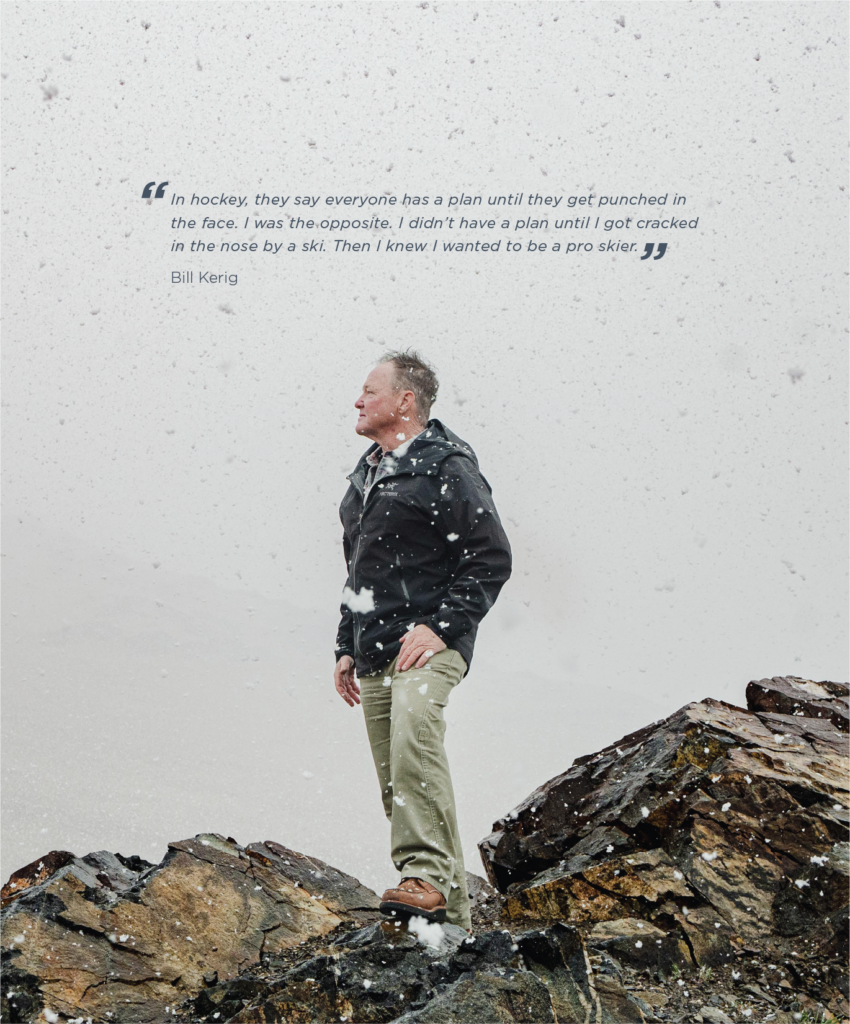
“In hockey, they say everyone has a plan until they get punched in the face,” says Kerig. “I was the opposite. I didn’t have a plan until I got cracked in the nose by a ski. Then I knew I wanted to be a pro skier.”
A Decade on Tour
Vail, Colorado, sits even higher than Snowbird. Moving up in elevation, if not the career ladder, Kerig relocates there to be at the center of the mogul tour.
He writes for the local newspaper, and—thanks as much to his press pass as his skiing talent—gets onto a team sponsored by K2, a popular ski brand.
When the team captain is injured, Kerig takes over and looks beyond the usual sponsors. He negotiates a deal with a fledgling company that’s launching a new product called an energy bar.
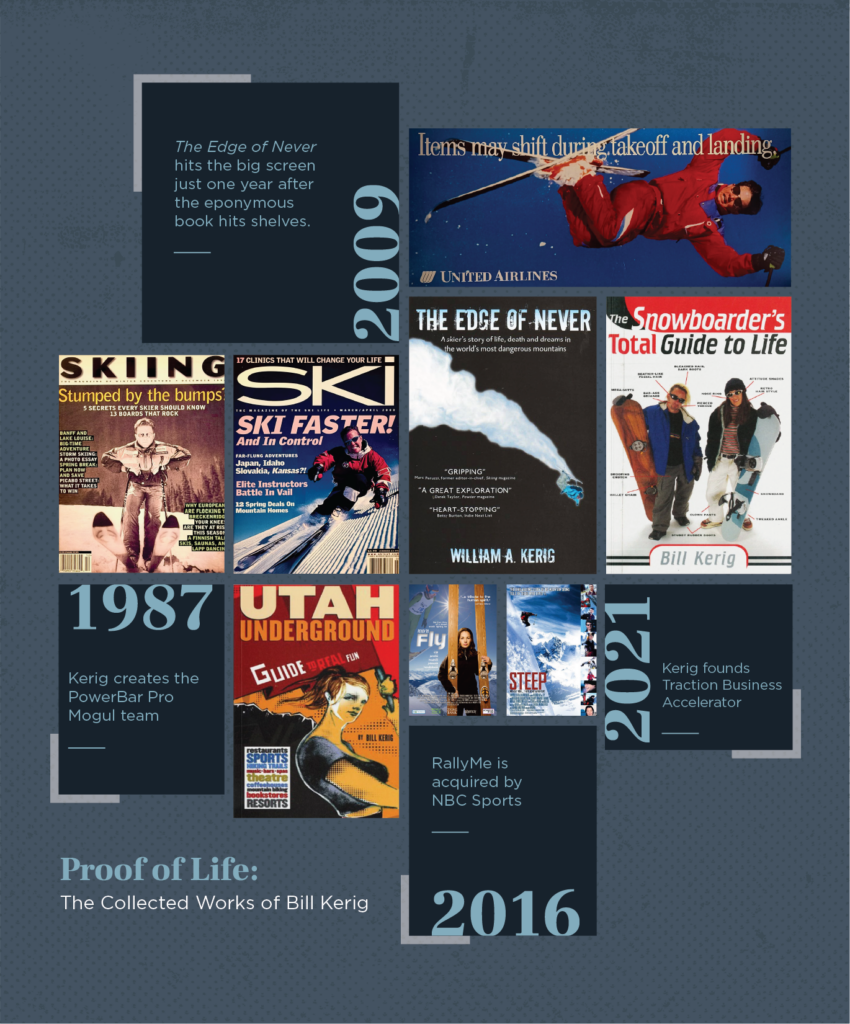
Kerig spends the next decade as captain of the K2 PowerBar Pro Mogul Team. He is officially a professional skier.
The Wandering Medium
While traveling, Kerig leverages his pro status to write and take pictures for a range of magazines. Eventually, he leaves the tour, creates his own magazine, The Wasatch Journal, and writes two books: The Snowboarder’s Total Guide to Life and Utah Underground.
When his curiosity moves again, this time to broadcast media, Kerig again taps his strength as a skier to pursue a pivot. He hosts the show Ski Tips on the Weather Channel; provides commentary for ESPN’s X Games; and works as a producer at both the 1998 (Nagano) and 2002 (Salt Lake City) Olympics. He even makes a murder mystery for 48 Hours on CBS.
A few years later, he uses the same strategy to transition from broadcast media to film.
On assignment for an article, Kerig befriends ski resort owner Kenny Griswold. They partner to make a movie called Net Worth, starring Daniel Baldwin and Craig Sheffer, about a group of friends competing to earn the highest net worth in 30 days, in a new city, with no cash or connections.
The process piques Kerig’s interest in film, but his focus shifts again, this time toward documentaries. First comes Steep, about big-mountain skiing, then Ready to Fly, about women’s ski jumping, which wins big at the Banff Film Festival.
His most ambitious project is The Edge of Never, which Kerig writes as a book before producing and directing the feature documentary. The story centers on a teenage skier attempting the backcountry route that killed his father, guided by a group of expert ski mountaineers.
Tech Entrances and Exits
A Boeing 737 wings over Iowa. It’s 2011 and Kerig is traveling with Ready to Fly protagonist Lindsay Van. They’re discussing a scene in which Van and another skier are at a farmers’ market with a folding table and a salad bowl, panhandling for their chance to compete in the Olympics.
Van recounts her humiliation at having to beg for money. Kerig commiserates. He raised a portion of the funds to produce this film through a rudimentary fundraising site he and a colleague created. “Where’s the crowdfunding platform for athletes?” Kerig asks. “Maybe I can build one.”
A year later, he has.
It’s called RallyMe, designed to help Olympic and amateur athletes raise money for training, travel, and competition. Van’s campaign is the first on the site. She raises almost twice her goal. Four years later, RallyMe is acquired by NBC Sports.
Kerig works with NBC for a while but leaves to launch another new idea: Great Coach, a website and app intended to increase transparency in youth sports. As a longtime hockey coach, he sees the need firsthand.
Great Coach makes a splash by publishing an aggregated list of coaches banned by various sports governing bodies. Then, the pandemic hits, and its revenue base vanishes almost overnight.
Rolling with the Punches
Kerig has to shut down a company he believes in. He loses money, including funds invested by his family and closest friends, and he’s almost 60. Most of his peers are stabilizing, not starting over.
Kerig doesn’t describe this time as failure, but the consequences were real. Financial collapse. Personal responsibility. The weight of a business that just didn’t work.
What stands out now is how he recalibrated.
“I just try not to get stuck,” he says. “If I think I’m heading in that direction, I’ll start working on something creative, even if I know it’s not going anywhere. Or I’ll reach out to people who need my help. It’s a strange kind of selfishness, but really listening and helping someone else not only makes me feel good, it keeps me moving.”
Movement is his other way to force recalibration. “Forward motion is the cure,” he says, “whether physical, creative, social, or professional.”
On Two Wheels
After Great Coach, Kerig takes the last of his money, buys two motorcycles, and heads north with his son on the Continental Divide Trail.
Like mogul skiing, adventure motorcycling demands focus. It means reading terrain, managing risk, and knowing when to adjust speed or direction, skills Kerig has spent decades developing.
He says this time on the trail freed his mind long enough to imagine finding success again.
“When you crash your bike in the middle of nowhere, you fix it and get back on,” says Kerig. “You have to keep going and do it with focus. This helped me reframe where I really was—not starting over at 60, just adjusting course and getting on with it.”
As for the physical risk of motorcycling, Kerig isn’t worried.
“I can calculate risk vs. return pretty quickly,” he says. “I can look at a ski slope where, if you fall, you die, and know immediately whether it’s worth it.”
The Risk of Retreat
Physical risk provides immediate feedback. Emotional and financial risks unfold over time, often without clear signals. They’re harder to read and control. Yet those are the risks Kerig continues to take.
“I think it’s a blessing to have to push through the discomfort of earning a living, because it keeps you engaged,” he says.
That word—engaged—comes up often. For Kerig, it seems disengagement is the real risk. He works hard to avoid stagnation but isn’t particularly worried about failing.
“Engaging with the world is sometimes really tiresome, but disengaging sounds worse,” he says. “All those skills you’ve built just atrophy and leave you weak and inconsequential.”
This perspective keeps him involved, and it gives him a way to move through periods and pivots he isn’t quite sure about. Leap and the net will appear.
Momentum and Reinvention
After the motorcycle trip to Canada, Kerig got a message from a former Great Coach employee. Julie Glusker was now head of U.S. Performance Academy (USPA), an online middle and high school for student-athletes. She wondered if Kerig might take a look at its business operations.
The school was 10 years old, sending kids to top colleges, but stuck in an unprofitable rut. Kerig met with its founder, Pete Smith, and interviewed much of the USPA team. He came on board to help scale its model, refine its offering, and navigate an exit.
Smith says Kerig didn’t give them a formula. Instead, he offered a journalist’s talent for listening, a tech founder’s toolbox, a filmmaker’s sense of successful narrative, and a team of proven freelancers.
“Bill won’t tell you what to do,” says Smith. “He’ll help you realize it yourself, then support you while you execute. He gave us confidence in the value of what we were doing. He kept us from compromising.”
Smith says, in their years working together, Kerig never once flexed his résumé. “His ego is completely checked at the door,” says Smith. “He’s a hoodie-and-hat kind of guy, even in business meetings.”
The two-way flow of trust between them led to a fourfold increase in revenue and a lucrative acquisition.
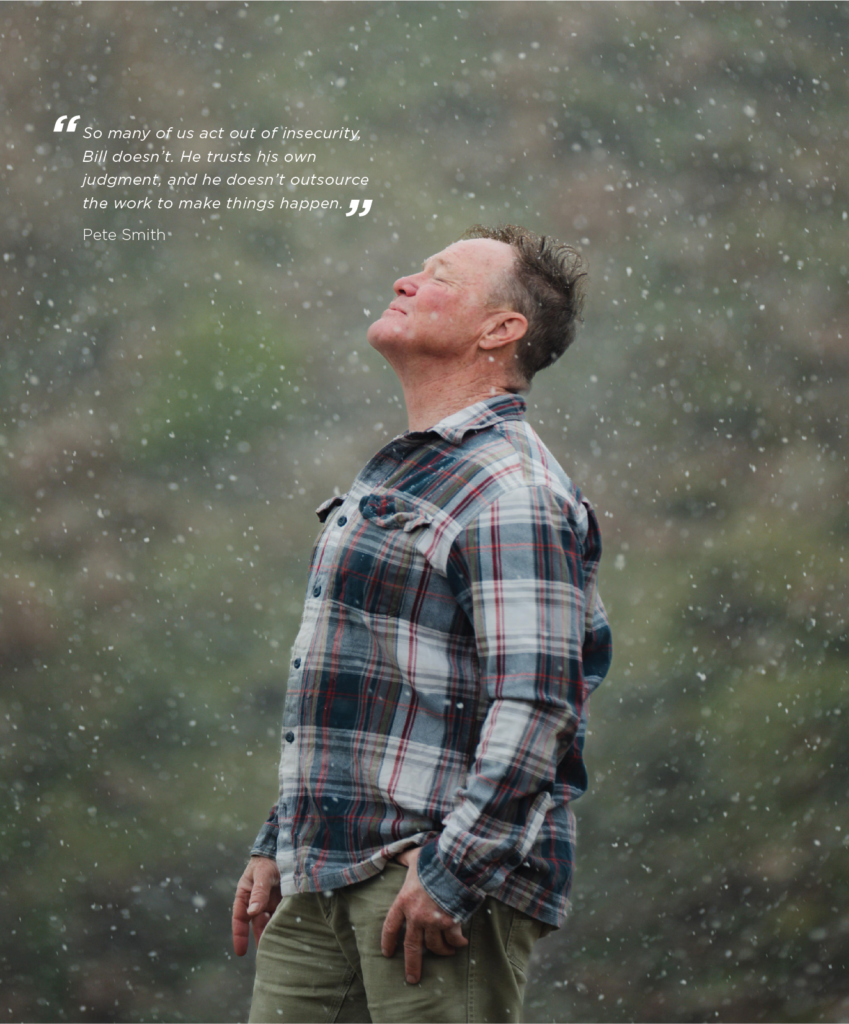
“So many of us act out of insecurity,” says Smith. “Bill doesn’t. He trusts his own judgment, and he doesn’t outsource the work to make things happen.”
Kerig enjoyed the experience so much he created what he says is his favorite company yet: Traction Business Accelerator. Through it, Kerig works with entrepreneurs facing personal and professional transitions, plus private equity firms looking for turnaround tactics for acquired companies.
Watching him, it’s easy to see he’s having as much fun helping others crack the code as he once had re-engineering his own life.
Trail as Old as Time
In 2025, Kerig had double knee-replacement surgery. Six months later, he blew out one of those knees again. For someone accustomed to constant motion, the result was debilitating.
Pain and anxiety set in, from the injury itself and the loss of momentum.
Kerig descended into despair. He called people to offer support, tried to write again, but wasn’t coming out of it. Confined by crutches and a doctor’s order not to put weight on the knee, he felt stuck.
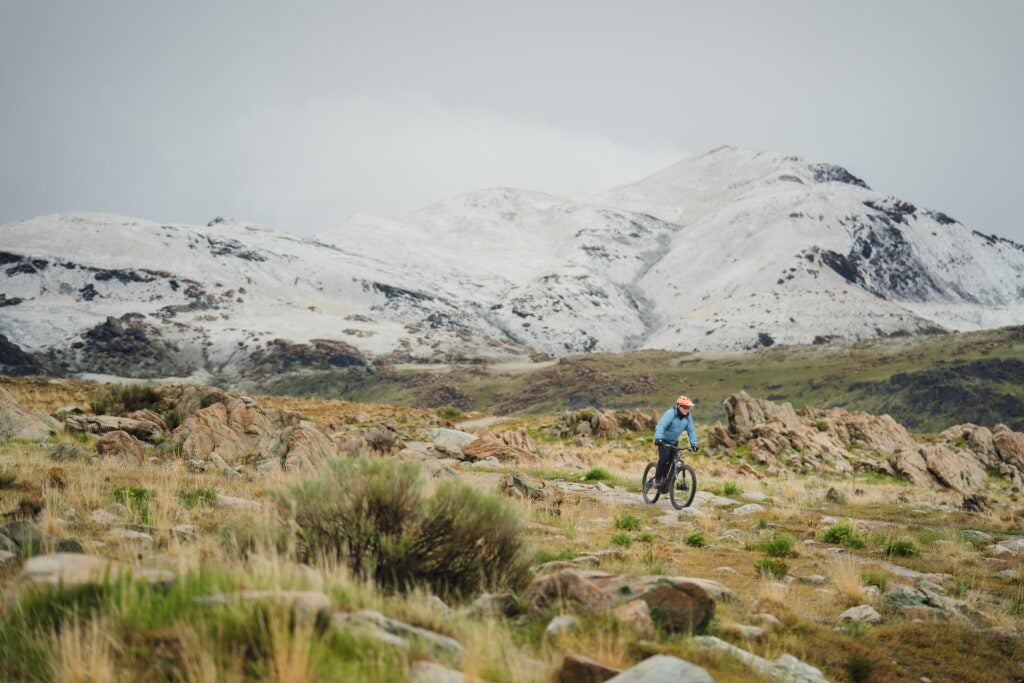
When his doctor finally gave him permission to ride a stationary bike at low resistance as a form of physical therapy, Kerig took it to the next level. He bought an e-bike with big, mountain-ready wheels and started looking for trails nearby.
Moving on the Moon
Accessed by a seven-mile causeway through the Great Salt Lake, Utah’s Antelope Island is a moonscape of billion-year-old metamorphic rocks. It’s a timeless chunk of land on an inland sea, where bison and antelope roam.
Kerig grabs his crutches and walks to the back of his truck. He lifts his e-bike slowly off the tailgate. With its electronic assistance, he says, he can control the resistance of the pedals and get moving, safely, outside.
There’s still snow on the island’s 6,500-foot Frary Peak when he tries his first ride, but the sandy trails lend traction. The effect is immediate.
“Being able to move through this beautiful space, to feel the wind and my heart beating faster, took me out of that darkness,” he says. “I know buying a bicycle is not what most adults would consider a mental-health strategy, but it worked.”
A Goal and a Plan
Kerig doesn’t view his life in terms of eras or pivots. He treats it as a series of decisions made with the information available and revised as necessary.
“To Bill, barriers are normal parts of the operating environment,” says Haugen. “He has challenges and setbacks. He doesn’t ignore them, but he doesn’t obsess about them either.”
This keeps Kerig from becoming rigid or defensive.
“In my experience, having a plan and rigidly sticking to it generally doesn’t work,” he says. “Having a clear goal with a loosely conceived plan has always worked better. Most of the meaningful things in my life came from taking paths I couldn’t have predicted.”
Into the Great Wide Open
The evening is warm with a breeze off the lake as Kerig—flushed from his bike ride and relieved to finally walk without crutches—pushes through the door of a neighborhood bistro. An aprés-adventure cocktail in hand, he reflects on a life shaped less by linear progression than by his own relentless participation.
“So far, adventure has mostly meant moving through space and time,” he says. “But one day, it could mean taking a wild ride through a great book. The conversations I’m having with my body aren’t going to be the same in 10 years, or 20. At some point, it will tell me, ‘No, we’re not doing that.’ In the meantime, I look at aging as a gift. Not everyone gets to do it.”
Now 64, Kerig is still in Salt Lake City, where he lives a sort of portfolio lifestyle through his 25-year-old production company, Thousand Faces Media, and his newest venture, Traction Business Accelerator.
It’s not always stable—in fact, on the day of our photo shoot, the funding fell through for a film he’s trying to make—but still, it keeps him engaged.
“Every time I start something new, I wonder if I can do it,” says Kerig. “Sure, I’ve pulled it off before, but I wouldn’t be human if I didn’t wonder: Will this be the time it doesn’t work out?”
For Kerig, the question isn’t rhetorical. It’s an invitation to keep moving and find out.
About the Author
Roxanne Bellamy is a freelance writer and editor, specializing in outdoor adventure and sustainability. In her 20-year career, she’s written for many industries, including beer, textiles, and finance. Her retirement dream is to be a National Geographic Explorer.